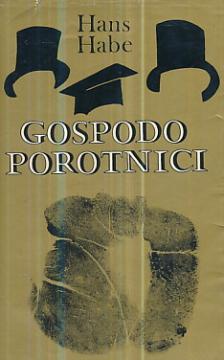
Gospodo porotnici
In the whirlwind of post-war Europe, where the ruins of the past mingle with the turmoil of a new beginning, Hans Habe's novel Gentlemen of the Jurors (1955) takes us through a tense story about justice, morality, and human weaknesses.
Set in the American occupation zone of Germany in 1947, the novel follows the fate of a young American officer, Lieutenant Lee Barton, who faces the chaos and corruption of a shattered world. Barton, an idealist who believes in justice, arrives in Munich as part of the occupation forces. His mission is simple – to participate in denazification and help restore the legal order.
But he soon becomes entangled in a web of moral dilemmas. Germany is a country of hungry, desperate people, where the black market and corruption flourish, and Barton falls in love with Anna, a young German woman whose past hides dark secrets connected to the Nazi regime. Their love, intertwined with guilt and suspicion, becomes a battleground between duty and passion.
When Barton discovers that Anna may be hiding the truth about her role in the war, he is faced with the question: is love stronger than justice? At the same time, his superior, a cynical colonel, warns him of the dangers of interfering in German lives. The trial of a former Nazi official further complicates the situation, as Barton realizes that justice is not black and white, but clouded by human weaknesses and political games.
Habe, a witness to the post-war chaos himself, masterfully portrays the moral complexity of occupied Germany. Through Barton and Anna, the novel explores questions of forgiveness, guilt, and the possibility of a new beginning in a world scarred by the wounds of war. Gentlemen of the Jury is a poignant story of the search for truth in a time when justice was often an illusion and love a fragile hope amidst the ruins.
Es werden zwei Exemplare angeboten
Kopiennummer 1
Kopiennummer 2
- Traces of patina
- Slight damage to the dust jacket