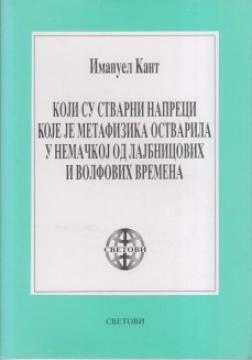
Koji su stvarni napreci koje je metafizika ostvarila u Nemačkoj od Lajbnicovih i Volfovih vremena

Kant re-examines the development of German metaphysics from Leibniz and Wolff to critical philosophy, exploring the limits of human reason and the possibility of reliable metaphysical knowledge.
What Real Progress Has Metaphysics Made in Germany Since the Time of Leibniz and Wolff? is a philosophical treatise by Immanuel Kant, one of the most important thinkers of the German Enlightenment and the founder of critical philosophy. The work was written in response to a prize question posed by the Berlin Academy of Sciences and was published posthumously in 1804.
Kant examines the development of German metaphysics following Gottfried Wilhelm Leibniz and Christian Wolff, two key figures of rationalist philosophy. In doing so, he questions whether metaphysical systems truly expanded human knowledge or merely refined conceptual constructs that lie beyond the scope of empirical verification.
The central theme of the work is the possibility of metaphysics as a science. Kant explores the relationship between reason and experience, the limits of theoretical knowledge, and questions regarding God, freedom, and the immortality of the soul. In contrast to traditional dogmatic metaphysics, he advocates for a critical examination of the conditions under which knowledge is possible at all.
He places particular importance on the distinction between what we can know and what we can merely think, demonstrating why metaphysics must re-examine its own methods and pretensions.
This treatise is valuable for understanding Kant’s relationship with the rationalist tradition, the development of transcendental idealism, and his efforts to secure a firm epistemological foundation for philosophy. It also represents a significant contribution to the history of German philosophy and to debates concerning the limits of human knowledge.
Angeboten wird ein Exemplar