George Sand
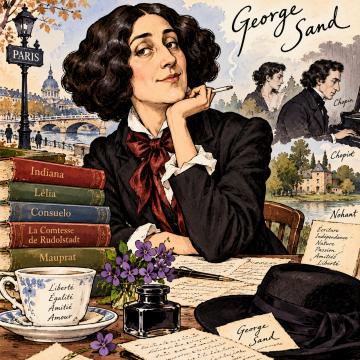
George Sand, the literary pseudonym of Amantine Lucile Aurore Dupin, née Dudevant (Paris, July 1, 1804 – Nohant, June 8, 1876), was a French writer, playwright, and one of the most significant figures of European Romanticism. She grew up on the family estate in Nohant, where the landscapes and rural life profoundly influenced her literary work. Following an unsuccessful marriage to Baron Casimir Dudevant, she moved to Paris, where she began an independent literary career.
She achieved literary success with the novel Indiana (1832), in which she critiques the social subordination of women and the constraints of marriage. This was followed by the novels Valentine (1832), Lélia (1833), and Jacques (1834)—works centered on themes of love, personal freedom, and the conflict between the individual and social norms. In the novels Mauprat (1837) and Consuelo (1842–1843), she explores moral maturation, art, and social inequality, while The Countess of Rudolstadt (La Comtesse de Rudolstadt, 1843–1844) serves as a continuation of the story of the musician Consuelo. Her body of work includes socially engaged novels such as The Companion of the Tour of France (Le Compagnon du tour de France, 1840), as well as pastoral works like The Devil's Pool (La Mare au diable, 1846), François the Foundling (François le Champi, 1848), and Little Fadette (La Petite Fadette, 1849)—works in which she idealizes rural life and emphasizes the values of labor, nature, and solidarity.
Sand was an advocate for women's rights, social justice, and republican ideals, participating actively in the intellectual and political life of France. She is also known for her relationships with the writer Alfred de Musset and the composer Frédéric Chopin. She left behind an extensive correspondence and an autobiography, Story of My Life (Histoire de ma vie, 1854–1855).
Through her prolific body of work—comprising novels, short stories, plays, essays, and autobiographical writings—George Sand exerted a profound influence on the development of French and European literature, becoming a symbol of literary independence and women's emancipation.
Titles in our offer
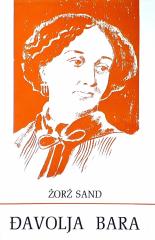
Đavolja bara / Mala Fadeta / Nahoče Fransoa
The Devil's Pond depicts the life of humble peasants in the French province of Berry. Little Fadette is the story of a girl named Fadette, who is rejected by her community because of her appearance and behavior. Intentional François tells the story of an
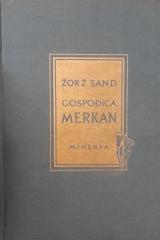
Gospođica Merkan
George Sand’s classic *Mademoiselle Merquem* (1953) is a psychological novel about a noblewoman who rejects social conventions and marriage in favor of independence, moral purity, and the pursuit of her own path in life.