Guy de Maupassant
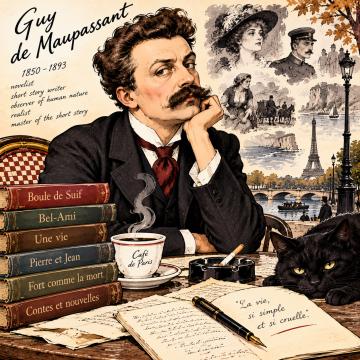
Henri René Albert Guy de Maupassant (Tourville-sur-Arques, Normandy, August 5, 1850 – Paris, July 6, 1893) was a French writer, one of the most significant figures of realism and naturalism, and a master of the short story. He grew up in Normandy, a region whose landscapes, inhabitants, and social dynamics profoundly influenced his work. He participated in the Franco-Prussian War (1870–1871), and his wartime experiences later became a key theme in his short stories. He worked as a civil servant in Paris while simultaneously developing his literary career under the mentorship of Gustave Flaubert.
He achieved literary fame with the short story Boule de Suif (1880), published in the collection Les Soirées de Médan. The work offers a sharp critique of social hypocrisy, class prejudice, and moral duplicity. During an exceptionally prolific creative period, he wrote approximately three hundred short stories, six novels, travelogues, and newspaper articles.
Among his most well-known novels are Une Vie (1883), Bel-Ami (1885), Mont-Oriol (1887), Pierre et Jean (1888), Fort comme la mort (1889), and Notre Cœur (1890). In them, he explores love, social advancement, greed, sexuality, family conflicts, and the transience of life.
Also significant are his short story collections The Tellier House (La Maison Tellier, 1881), Tales of the Woodcock (Contes de la bécasse, 1883), Miss Harriet (1884), and The Horla (Le Horla, 1887). His fantastic and psychological tales hold a special place; they delve into themes such as fear, madness, loneliness, and the unreliability of human perception.
Maupassant’s style is characterized by conciseness, precision of expression, irony, and a keen observation of human nature. He spent the final years of his life battling a severe illness and psychological disorders. He died in Paris at the age of 42. His literary legacy has profoundly influenced the development of the modern short story and realist prose worldwide.
Titles in our offer



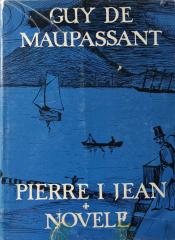


Put u mrak
This book collects seventeen of Maupassant's short stories, which reflect the origin and development of the writer's illness - his journey into darkness. Hence the collective title, which the translator used to emphasize how these short stories form a who

Yvette
Although Yvette is a novella of fashionable life, written in an elegant manner, it cannot be considered merely a likable drawing room. Yvette is much more complex.