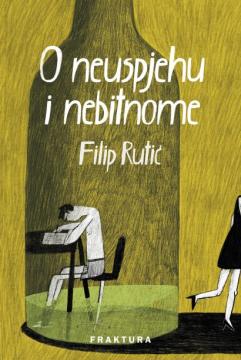
O neuspjehu i nebitnome

O neuspjehu i nebitnome

Filip Rutić

Filip Rutić wrote an uncompromising, great generational novel that can be read in one's breath about the moments when we stop being young and become adults. About failure and the unimportant is a novel about young people who are losers in a world that is

The unnamed hero of Filip Rutić's brilliant debut On Failure and the Unimportant is a chronically unsuccessful sociology student who is not even sure why he is studying. He knows that there is no secure job waiting for him after college, he is intelligent and cynical, capable and unmotivated, like most of his friends he is afraid of an uncertain future, but he is sure of only one thing - that he wants to become a writer.

When he falls madly in love with the young Anđela, a vegetarian who is the complete opposite of him, meticulous and determined to succeed, motivated to exercise every morning and fulfill her college obligations, she becomes the possibility of his change. Things, of course, are never that simple. We will love Rutić's hero both self-destructive, hungover, and resigned, we will be angry with him because he misses obvious opportunities or takes love for granted. But we will understand his constant feeling of not belonging in the search for himself.

"I find her covered up to her chin in the room. He apologizes to me. She is too hungry and has so much to do today. I feel like the biggest jerk. What gives me the right to be offended because she doesn't want to fuck? It's such a sneaky way of blackmailing. And when I'm already so aware of everything, why doesn't it stop? I disobey my own orders. A part of me seems to accept this duality. I kiss her on the forehead and say that everything is fine. That crappy expression is still there anyway. I feel his weight, I avoid her gaze. I try to smile, but what the lips are doing is not a smile. I go back to bed to hug her. We stay lying down."

Editor
Monika Herceg
Graphics design
Klara Rusan
Dimensions
20.5 x 14 cm
Pages
200
Publisher
Fraktura, Zaprešić, 2023.
 
Latin alphabet. Hardcover with dust jacket.
Language: Croatian.
ISBN
978-9-53358-543-7

One copy is available

Condition:Unused
 

Are you interested in another book? You can search the offer using our search engine or browse books by category.

You may also be interested in these titles

Senzualna žena

Senzualna žena

J

The first how-to book for a woman who wants to be whole.

Otokar Keršovani, 1972.
Croatian. Latin alphabet. Hardcover with dust jacket.
5.104.08
Tajanstveni brod

Tajanstveni brod

Gustav Renker

"The Mysterious Ship" by Gustav Renker is an adventure-suspense novel with elements of mystery, the kind this Swiss writer often wrote in the mid-20th century.

Džepna knjiga, 1955.
Serbian. Latin alphabet. Paperback.
3.60
Tihi Don : druga knjiga

Tihi Don : druga knjiga

Mihail Šolohov

An epic novel about the life of the Don Cossacks on the eve of and during World War I, the October Revolution, and the Civil War. A powerful story about love, war, revolution, and the fate of an individual in the whirlwind of history. Abridged popular edi

Kultura, 1963.
Serbian. Latin alphabet. Paperback.
3.00
Sjene ljubavi

Sjene ljubavi

Janko Leskovar

A key novel of Croatian modernity. Leskovar depicts the overly sensitive writer Marcel Bušinski, who sinks in passive decadence into the shadows of unrealized, painful love, introspection, and mental weakness. First edition.

Štamparija Karla Albrechta (Jos. Wittasek), 1898.
Croatian. Latin alphabet. Hardcover.
23.56
Seljaci IV: Ljeto

Seljaci IV: Ljeto

Władysław Stanisław Reymont

Peasants IV: Summer is the final and most powerful part of the epic tetralogy Peasants. The culmination of the conflict in the village of Lipce during the hot summer and harvest, the drama surrounding Jagna, the death of Maciej Boryna and the final closin

Matica hrvatska, 1935.
Croatian. Latin alphabet. Hardcover.
7.26 - 23.54 (set)
Seljaci III: Proljeće

Seljaci III: Proljeće

Władysław Stanisław Reymont

The third part of the epic tetralogy The Peasants. Spring brings the awakening of nature, but also new conflicts in the village of Lipce: the culmination of a love triangle, family drama and social tensions. The continuation of Nobel's epic of Polish peas

Matica hrvatska, 1934.
Croatian. Latin alphabet. Hardcover.
7.32 - 23.54 (set)