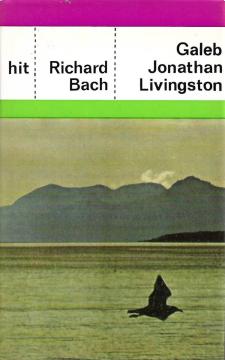
Galeb Jonathan Livingston

Galeb Jonathan Livingston

Richard Bach

The allegorical story of Jonathan the seagull has been one of the best-selling classics of spiritual-philosophical literature for decades, and millions of people consider it to have changed their lives. With Galeb Jontahan Livingston, we will fly to (un)k

The novel is written in short and clear sentences understandable by most ages. Along with the abundant interweaving of various storytelling techniques, we meet monologue, dialogue, description used to evoke various types of flying, and storytelling that evokes the life and behavior of seagulls. Elements of today's life can be found in many sentences.

Seagull Jonathan Livingston stands out from the flock because of his great desire to learn to fly as well as possible. Although he tried to fit in with the other seagulls, due to new flight experiments the flock ostracized him and he practiced in solitude. He soon encounters like-minded people and reaches incredible flying speeds that enable him to "jump" through space and time. He is also taught by the brave seagull Zhang. Jonathan had the need to return to his flock on Earth and in the end he himself becomes a teacher to the seagulls who, like him once, dared to fly freely and were ostracized. There were more and more of them. In the end, Johnatan moves on because he has done his job - he taught the other seagulls that there are no limits in the race for knowledge.

Original title
Jonathan Livingston Seagull
Translation
Diana Pavičić-Haniš
Editor
Zlatko Crnković
Illustrations
Russell Munson
Graphics design
Alfred Pal
Dimensions
20 x 12 cm
Pages
93
Publisher
Znanje, Zagreb, 1979.
 
Latin alphabet. Hardcover with dust jacket.
Language: Croatian.

No copies available

The last copy was sold recently.

 

Are you interested in another book? You can search the offer using our search engine or browse books by category.

You may also be interested in these titles

Topaz

Topaz

Leon Uris

Topaz is a Cold War suspense novel by Leon Uris, published in 1967 by McGraw-Hill. The novel spent one week atop The New York Times Best Seller List, and was Uris's first New York Times number-one bestseller since Exodus in 1959.

Otokar Keršovani, 1970.
Croatian. Latin alphabet. Hardcover with dust jacket.
8.68
Čistoća

Čistoća

Jonathan Franzen

Fourteen years after "Corrections" and five years after "Freedom," Franzen wrote another great novel, "his most intimate yet, in which he added some new tones to his voice.

V.B.Z, 2015.
Croatian. Latin alphabet. Paperback.
13.56
Obećaješ li da nećeš nikome reći?

Obećaješ li da nećeš nikome reći?

Mary Jane Clark

The novel Will You Promise Not to Tell? (2000), the second part of the series about KEY News journalists, is a tense crime thriller set in the world of high-stakes auctions and hidden secrets of New York.

Naklada AS, 2004.
Croatian. Latin alphabet. Hardcover.
3.48
V.

V.

Thomas Pynchon

The novel represents a journey into an alternative world – a world that we all belong to from time to time, but of which we would not want to be a part, a world of paranoia and alienation that we are not entirely sure is just an alternative or the bare tr

Čarobna knjiga, 2010.
Serbian. Latin alphabet. Paperback.
21.98
Gazela i Kosac

Gazela i Kosac

Margaret Atwood

Margaret Atwood described the novel as speculative fiction and adventure romance rather than pure science fiction, as it does not deal with things that "we cannot yet do or begin to do", but it goes beyond the amount of realism she associates with the nov

Profil International, 2003.
Croatian. Latin alphabet. Paperback.
10.76
Zemlji i nebu

Zemlji i nebu

John Steinbeck

Steinbeck's early work from 1933, written with difficulty, announces motifs from East of Eden. A hit among lovers of mysticism and ecology - a mystical novel about man's deep connection with the earth and the conflict between pagan spirituality and Christ

Svjetlost, 1961.
Serbian. Latin alphabet. Paperback.
4.56