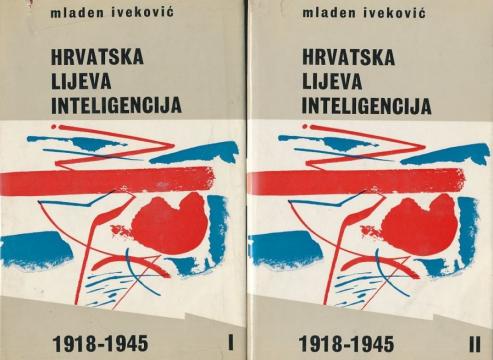
Hrvatska lijeva inteligencija : 1918 - 1945

Hrvatska lijeva inteligencija : 1918 - 1945

Mladen Iveković

"Croatian Left Intelligence 1918–1945" is a two-volume work that analyzes the role and activities of the Croatian left-wing intellectual elite in the period between the two world wars and during World War II.

The first volume covers the period from 1918 to 1941, focusing on the political, social and cultural conditions that shaped the left-wing intelligentsia in the Kingdom of Serbs, Croats, Slovenes and Slovenes and the Kingdom of Yugoslavia. The second volume covers the period from 1941 to 1945, exploring the contribution of the left-wing intelligentsia to the anti-fascist movement and the People's Liberation Struggle.

The book shows in detail how intellectuals, through magazines, literature and political engagement, influenced the formation of left-wing thought in Croatia. Special attention is paid to their role in the development of Marxist ideology, the fight against fascism and their contribution to cultural and political life. The work also analyzes the relations between the left-wing intelligentsia and the Communist Party, and their cooperation in shaping the political discourse of the time.

Published in 1970, the book represents a significant contribution to understanding the history of the Croatian intellectual left and its role in key historical events of the first half of the 20th century.

Dimensions
20 x 15 cm
 
The book consists of two volumes.
Pages total
752
Publisher
Naprijed, Zagreb, 1970.
 
Latin alphabet. Hardcover with dust jacket.
Language: Croatian.

No copies available

The last copy was sold recently.
 

Are you interested in another book? You can search the offer using our search engine or browse books by category.

You may also be interested in these titles

Zbornik radova o Dobriši Cesariću

Zbornik radova o Dobriši Cesariću

Vladimir Kovačić, Antun Bonifačić, Mladen Iveković, Milan Bogdanović, Ivo Frol, Ivo Ladika, Radom...
Hrvatska akademija znanosti i umjetnosti (HAZU), 1992.
Croatian. Latin alphabet. Hardcover with dust jacket.
19.99
Filozofija revolucije

Filozofija revolucije

Gamal Abdel Nasser

G. A. Nasser's Philosophy of Revolution is a political manifesto and ideological program of the Egyptian Revolution of 1952. In it, Nasser explains the motives of the revolution, the role of Egypt in the Arab and African world, and the vision of Arab nati

Džepna knjiga, 1956.
Serbian. Latin alphabet. Paperback.
9.56
Sudbonosni podvig Jugoslavije: Podsjećanje na historijsko NE staljinizmu, događaj koji je opredijelio budućnost Jugoslavije

Sudbonosni podvig Jugoslavije: Podsjećanje na historijsko NE staljinizmu, događaj koji je opredijelio budućnost Jugoslavije

Raif Dizdarević

The book by Raif Dizdarević, one of the last living actors of Yugoslav diplomacy, presents his reconstruction of the most fateful moment of post-war Yugoslavia – the split with Stalin and the Informburo in 1948–1953.

Udruženje za modernu historiju (UMHIS), 2018.
Croatian. Latin alphabet. Paperback.
23.58
Snažan eho brionski: Odjeci Brionskog plenuma u Bosni i Hercegovini 1966. godine

Snažan eho brionski: Odjeci Brionskog plenuma u Bosni i Hercegovini 1966. godine

Amir Duranović

Amir Duranović's book reconstructs in detail the dramatic year 1966 and the Fourth (Brion) Session of the Central Committee of the Communist Party of Yugoslavia (July 1–2, 1966), at which Aleksandar Ranković, the long-time head of the UDB and vice preside

Udruženje za modernu historiju (UMHIS), 2017.
Croatian. Latin alphabet. Paperback.
9.54
Hitler osvajač: raskrinkavanje jedne legende

Hitler osvajač: raskrinkavanje jedne legende

Rudolf Olden

One of the first anti-Hitler works, published by Nolit as early as 1933. This is an early, shorter version of the work (originally published anonymously in Prague), which preceded the expanded edition from Amsterdam in 1935.

Nolit, 1933.
Croatian. Latin alphabet. Hardcover with dust jacket.
15.32
O međunarodnoj situaciji

O međunarodnoj situaciji

Andrej A. Ždanov

A. A. Zhdanov's report from the founding meeting of the Informbiro (Poland, September 1947) on the division of the world into two camps – imperialist (USA) and anti-imperialist (USSR). A key document of the beginning of the Cold War.

Kultura, 1947.
Serbian. Cyrillic alphabet. Paperback.
7.46