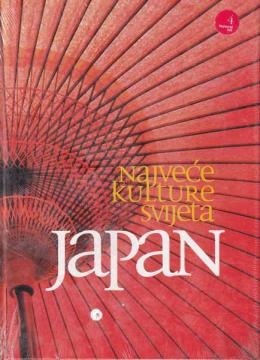
The Greatest Cultures of the World is a collection of eight books that talk about the world's great civilizations. The books were first published in Croatia in 2005 in Rijeka by the publisher Extrada d.o.o., but all eight books were also published specifi
The book The Arctic Homeland of the Vedas (1903) by the Indian scholar Tilak proposed the hypothesis that the ancient Aryans, the authors of the Rigveda, originated in the Arctic region. Although controversial, the book remains important in the study of V
NIRO Književne novine, 1987.
Serbian. Latin alphabet. Paperback.
17.56 €
History of Civilizations • History of Europe • Greece and Rome
The fifth volume covers the final phase in the history of the Roman Empire, the rise of Byzantium and its adoption of the traditions of ancient Rome, as well as the history of Europe after the Great Migration of Peoples. The book ends with the expansion o
Europapress holding, 2007.
Croatian. Latin alphabet. Hardcover.
7.34 - 7.64 €
20th Century • Communism and fascism • History of Civilizations • Political-historical essays • Diplomacy • Security and military strategy
This collection of political essays and analysis by Isaac Deutscher covers key events from 1953 to 1966, providing insight into the relationship between the Soviet Union, China, and the Western powers.
Centar društvenih djelatnosti saveza socijalističke omladine hrvatske, 1979.
Croatian. Latin alphabet. Paperback.
6.244.37 - 6.26 €
History of Civilizations • Encyclopedia, Dictionaries & Lexicons
British historian Ian Wilson (known for his books on the Shroud of Turin and Jesus) offers the most thorough defense of the thesis that the biblical flood was a real historical event, not just a myth, in his work Before the Flood.
Stari grad, 2007.
Croatian. Latin alphabet. Hardcover.
16.22 - 16.32 €
Svjetska povijest • History of Civilizations • Popular Science • Anthropology • Political-historical essays
Michael A. Cook, Princeton professor of Islamic history, provides an overview of human history from the Neolithic to the fall of the Twin Towers in 2001 in this witty and intelligent synthesis, asking the key question: why did everything happen exactly th