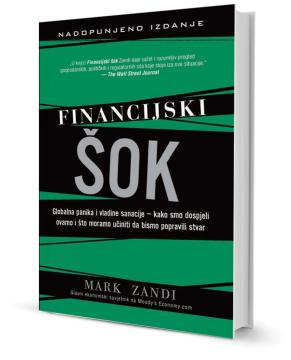
Financijski šok: globalna panika i vladine sanacije

Financijski šok: globalna panika i vladine sanacije

Mark Zandi

The subprime mortgage crisis caused the financial market crash and the global economic crisis. The author explains in a simple and clear way the causes of the crisis, from the collapse of real estate ownership to the mistakes of Alan Greenspan, former cha

The book begins with a brief ‘history’ of the crisis – where it began, how it spread and what its consequences were. The author then illuminates the deeper causes of the crisis, such as the psychology of homeownership, demystifies the complex financial engineering that allowed renters to hide the growing risks and shows how investors, on a global scale, turned a deaf ear to the potential dangers, despite key warning signs.

Summary:

  • A brief overview of subprime mortgages
  • Assessing subprime mortgages
  • Everyone has a right to a home
  • Governor Greenspan is counting on residential real estate
  • Global financiers want their share
  • Bad lenders crowd out the good ones
  • Financial engineers and their creations
  • The downfall of the builders
  • Regulatory change
  • Explosion, bubble, crash and bust
  • The credit crunch
  • Timid lawmakers become bold
  • Economic consequences
  • Back to the future

Original title
Financial shock
Translation
Igor Gvozdanović
Dimensions
23 x 15 cm
Pages
288
Publisher
Mate d.o.o, Zagreb, 2017.
 
Latin alphabet. Paperback.
Language: Croatian.
ISBN
978-9-53246-089-6

One copy is available

Condition:New
 

Are you interested in another book? You can search the offer using our search engine or browse books by category.

You may also be interested in these titles

The Welfare State We're in

The Welfare State We're in

James Bartholomew
Politico's Publishing, 2004.
English. Latin alphabet. Hardcover with dust jacket.
15.22
Borba za nov međunarodni ekonomski poredak

Borba za nov međunarodni ekonomski poredak

Marko Vrhunec
Rad, 1979.
Serbian. Latin alphabet. Paperback.
4.98
Kraj siromaštva: Ekonomske mogućnosti našeg doba

Kraj siromaštva: Ekonomske mogućnosti našeg doba

Jeffrey Sachs

In the book, economist Jeffrey Sachs presents an optimistic plan for eliminating extreme poverty by 2025. He argues that this is feasible with political will, because world wealth is growing, and poverty is not fate, but the result of inefficient systems.

Algoritam, 2007.
Croatian. Latin alphabet. Paperback.
9.78
Nova industrijska država

Nova industrijska država

John Kenneth Galbraith

Technocracy Record Book

Stvarnost, 1970.
Croatian. Latin alphabet. Paperback.
5.26 - 5.48
Za svijet bez siromaštva - Socijalna poduzeća i budućnost kapitalizma

Za svijet bez siromaštva - Socijalna poduzeća i budućnost kapitalizma

Muhammad Yunus, Karl Weber
VBZ, 2009.
Croatian. Latin alphabet. Paperback.
9.98
Strani privatni kapital i razvoj nerazvijenih zemalja - Neka iskustva Azije

Strani privatni kapital i razvoj nerazvijenih zemalja - Neka iskustva Azije

Blagoje S. Babić

The book explores the role of foreign capital in the development of underdeveloped countries. This book studies experiences from Asia and analyzes how foreign capital can contribute to economic progress.

Institut za međunarodnu politiku i privredu, 1982.
Serbian. Latin alphabet. Hardcover with dust jacket.
9.98