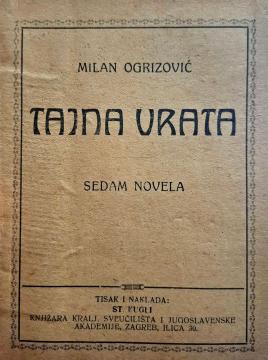
Tajna vrata: sedam novela
This psychological-fantasy novella by Milan Ogrizović (1907) follows a protagonist who, through a hidden door, enters a mysterious, ghostly world of his own subconscious, anxieties, and unexplored fears.
The novella "The Secret Door" (Tajna vrata) was published in 1907 (and later included in the collection The Secret Door and Other Tales) and serves as a quintessential example of Croatian Moderna (Modernism), bearing distinct influences of Symbolism, Decadence, and psychoanalysis. Unlike realist prose, which typically addresses social issues, Ogrizović here focuses on the individual’s inner world—their psyche, sense of isolation, and the blurred boundary between reality and hallucination. The narrative follows an introspective protagonist who discovers a hidden door within an old, somewhat neglected space. Opening this door leads not merely into an unknown room, but serves as a potent symbolic transition into the depths of the human subconscious—a realm of repressed memories, erotic longings, and existential dread. Through an atmosphere steeped in mystery, anxiety, and melancholy—often likened to the poetics of Edgar Allan Poe—Ogrizović builds tension on a psychological level rather than through external action. "The Secret Door" holds a significant place in the history of Croatian literature as an early specimen of modern psychological and fantastic prose, in which physical space becomes a projection of the human state of mind.
Jedan primjerak je u ponudi