Jean-Paul Sartre
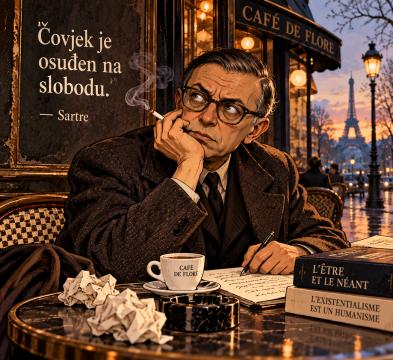
Jean-Paul Sartre (Paris, June 21, 1905 – Paris, April 15, 1980) was a French philosopher, writer, playwright, essayist, and political intellectual, as well as one of the most influential figures of existentialism and 20th-century European thought. His work is characterized by themes of human freedom, responsibility, identity, alienation, and the individual's relationship with society.
He studied philosophy at the École normale supérieure in Paris, where he met Simone de Beauvoir, a philosopher and writer with whom he maintained a lifelong intellectual and personal partnership. He worked as a philosophy teacher; during World War II, he was conscripted into the military and spent some time in German captivity.
He achieved literary acclaim with the novel Nausea (1938), in which he explores the absurdity of existence and the human relationship to the world through the experience of the protagonist. The short story collection The Wall and the unfinished novel cycle The Roads to Freedom further develop his existentialist themes.
His most important philosophical work, Being and Nothingness (1943), presents an extensive analysis of consciousness, freedom, bad faith, and the relationship with the Other. In the lecture Existentialism Is a Humanism (1946), he popularized the fundamental idea that existence precedes essence—meaning that a person shapes who they are through their own choices.
Sartre was also a successful playwright. In works such as The Flies, No Exit, and Dirty Hands, he explored moral conflicts, responsibility, and political engagement. His significant philosophical and essayistic works include Critique of Dialectical Reason, What Is Literature?, and The Words—an autobiographical work dedicated to his childhood and his relationship with writing.
He was politically active and close to Marxism, yet also critical of various forms of repression. Through his public engagement, he influenced debates on freedom, colonialism, revolution, and the responsibility of intellectuals.
In 1964, he was awarded the Nobel Prize in Literature, which he declined, believing that a writer should not accept official honors. Sartre left behind an exceptionally rich philosophical and literary body of work that continues to hold a significant place in contemporary humanities.
Titel im Angebot
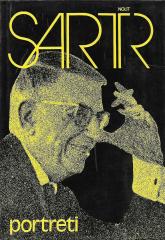
Izabrana dela 7: Portreti
A collection of philosophical essays, polemics, portraits, and interviews concerning freedom, literature, and the role of the intellectual. Sartre reflects on Descartes, Camus, Nizan, and Merleau-Ponty, as well as his own intellectual journey.
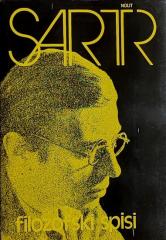
Izabrana dela 8: Filozofski spisi
Pet ključnih Sartreovih filozofskih tekstova o emocijama, imaginaciji, svijesti, egu i ljudskoj slobodi. Vrijedan uvod u fenomenologiju i egzistencijalizam jednog od najvećih mislilaca 20. stoljeća.
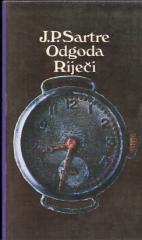
Odgoda / Riječi
Dva značajna Sartreova djela o slobodi, odgovornosti i oblikovanju osobnog identiteta. Roman o Europi uoči Drugoga svjetskog rata i autobiografsko promišljanje djetinjstva, književnosti i pisanja.