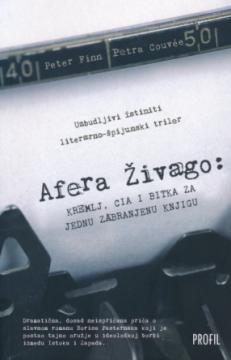
Afera Živago: Kremlj, CIA i bitka za jednu zabranjenu knjigu

Afera Živago: Kremlj, CIA i bitka za jednu zabranjenu knjigu

Peter Finn, Petra Couvée

A dramatic, previously untold story about Doctor Zhivago and a time when literature had the power to change the world

The story of Boris Pasternak's famous novel that became a secret weapon in the ideological struggle between East and West. The story of this famous case begins in May 1956 when an Italian publisher traveled by train to a distant Russian province with the intention of visiting one of the most popular Russian poets, Boris Pasternak, who entrusted him with his first, eagerly awaited novel with the words: "This is Doctor Zhivago. May God grant that it may travel the world." Pasternak knew all too well that his novel would never be published in the USSR, where the authorities considered it an attack on the Revolution, which is why he approved its publication abroad. But the CIA, which considered the Cold War primarily an ideological struggle, published the novel in Russian in 1958 and smuggled it into the USSR, where it was snatched up on the black market and stolen from hand to hand. The authors of this book, the only ones who had access to the CIA's secret files, give us an exciting portrait of the charming and passionate Pasternak, but also a tense thriller that gives us the opportunity to get acquainted with the fascinating time of the Cold War and takes us to a time when literature had the power to change the world.

Titel des Originals
The Zhivago affair: the Kremlin, the CIA, and the battle over a forbidden book
Übersetzung
Mijo Pavić
Editor
Maroje Mihovilović
Maße
23 x 15 cm
Seitenzahl
286
Verlag
Profil Knjiga, Zagreb, 2015.
 
Latein Schrift. Taschenbuch.
Sprache: Kroatisch.

Angeboten wird ein Exemplar

Zustand:Gebraucht, in sehr gutem Zustand
Zum Warenkorb hinzugefügt!
 

Interessieren Sie sich für ein anderes Buch? Sie können das Angebot über unsere Suchmaschine suchen und finden oder Bücher nach Kategorien durchsuchen.

Diese Titel könnten Sie auch interessieren

60 godina Radio Osijeka (1943. – 2003.)

60 godina Radio Osijeka (1943. – 2003.)

Zlata Živaković-Kerže, Samir Klasiček, Amoreta Hofšauer Bajto

The monograph, published in 2003 in Osijek, commemorates six decades of continuous operation of Radio Osijek – one of the oldest and most influential regional radio stations in Croatia.

Grafika, 2003.
Kroatisch. Latein Schrift. Taschenbuch.
5,46
Tajne nogometnog huliganizma: Kako se mijenjala slika nogometnog nasilja

Tajne nogometnog huliganizma: Kako se mijenjala slika nogometnog nasilja

Dougie Brimson

A sharp analysis of the phenomenon of football hooliganism. A historical overview from the beginnings to the 2000s, the causes, methods, organization of groups, police measures and why violence persists despite bans. An honest, controversial inside look.

Celeber, 2006.
Kroatisch. Latein Schrift. Taschenbuch.
8,36
Bilježnica Robija K.

Bilježnica Robija K.

Viktor Ivančić

Robi's Notebook by K. Viktor Ivančić is a satirical book written in the form of a diary of an eight-year-old boy, Robi, through whose seemingly naive perspective the social and political absurdities of Croatia in the early 1990s are revealed.

Feral Tribune, 1994.
Kroatisch. Latein Schrift. Taschenbuch.
22,36
Obama – Vanjskopolitička doktrina

Obama – Vanjskopolitička doktrina

Jeffrey Goldberg

The American president talks about his toughest decisions about America's role in the world.

Mate d.o.o, 2016.
Kroatisch. Latein Schrift. Taschenbuch.
9,49
Kako ste?

Kako ste?

Barbara Matejčić

Knjiga sadrži šest velikih novinskih reportaža koje opisuju šest skupina marginaliziranih u hrvatskom društvu, pri čemu junaci tih reportaža nisu tipovi, nego samosvojni, hrabri i individualizirani.

Heinrich Boll Stiftung, 2015.
Kroatisch. Latein Schrift. Taschenbuch.
9,98
Kako što nastaje: novine, film, teatar

Kako što nastaje: novine, film, teatar

Karel Čapek

In a witty and instructive essay, Čapek describes how a newspaper, a film, and a theater play are created. Through humor and irony, he shows the complexity of the process – from idea to realization – and the different perspectives of the participants, dem

Znanje, 1985.
Kroatisch. Latein Schrift. Taschenbuch.
4,76