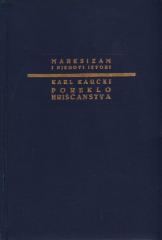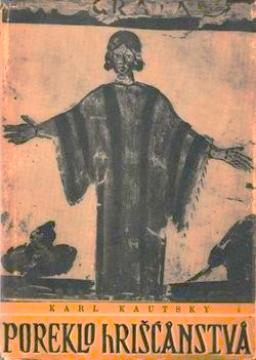
Poreklo hrišćanstva
A significant Marxist study that explains the emergence of the early Christian Church through a historical-materialist analysis of socioeconomic conditions and class struggles in ancient Rome and Judea.
The Origins of Christianity is one of Karl Kautsky’s best-known and most influential theoretical works, in which the author applies the method of historical materialism to the study of the emergence and early history of Christianity. Kautsky rejects traditional theological explanations, approaching the phenomenon of the new religion primarily as a social and economic movement that arose within the specific historical circumstances of the ancient world. The book is divided into several thematic sections that provide a detailed analysis of the social and economic conditions in the Roman Empire and Hellenistic Judea—including the decline of the slave-based system, the ruin of the peasantry, the rise of a proletariat, and the pervasive moral and social crisis of the era. Kautsky portrays early Christianity as a movement of the poor, the oppressed, and the disenfranchised, who sought an escape from the hardships of their daily lives through communal meals and the ideal of equality. The author traces the evolution of the early Christian movement from a radical—even revolutionary—community into one that gradually adapted to the prevailing order, eventually transforming into a hierarchical ecclesiastical organization. Written in a clear, analytical style, this work remains a classic example of Marxist historiography and the sociology of religion.
Angeboten wird ein Exemplar
- The cover is missing