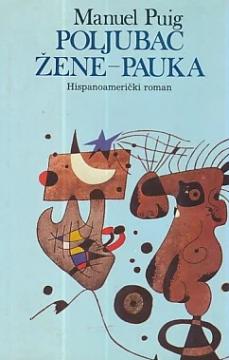
Poljubac žene-pauka

Poljubac žene-pauka

Manuel Puig

The book, banned in Argentina from 1976 to 1983 due to its political and social themes, is considered Puig's most successful work. It was adapted into a film in 1985, a musical, and a stage play.

The novel "Kiss of the Spider Woman" by Argentine writer Manuel Puig, first published in 1976 (Croatian edition 1985), is a provocative story of love, friendship, victimization, and fantasy, set in a prison cell in Buenos Aires. The plot follows two prisoners: Valentino Arregui, a 26-year-old political activist arrested for revolutionary activities, and Luis Molina, a 37-year-old homosexual convicted of seducing a minor. Despite their obvious differences, the two develop a deep emotional and physical bond.

Molina, a charming fan of popular culture, recounts the plots of five melodramatic films to Valentino to kill time, and these films serve not only as an escape from prison reality, but also as a means of characterizing the characters and exploring their inner conflicts. At the same time, Molina is tasked by the prison authorities to extract information about Valentino's illegal group in exchange for freedom, which introduces an element of tension and moral dilemma.

Puig uses an unconventional novel form, with almost no traditional narrator, relying on dialogue, cinematic retellings, and footnotes that discuss homosexuality and social norms. The novel explores themes of identity, sexuality, political resistance and the power of popular culture, questioning social and genre conventions in the spirit of postmodernism. His lively, spoken language and screenwriting approach make the work drinkable, but deeply layered.

Titel des Originals
El beso de la mujer arana
Übersetzung
Dubravka Popović Srdanović
Editor
Milan Komnenić
Titelseite
Nebojša Jehlička
Maße
20,5 x 13,5 cm
Seitenzahl
258
Verlag
Prosveta, Beograd, 1985.
 
Auflage: 8.700 Exemplare
 
Latein Schrift. Fester Einband mit Schutzumschlag.
Sprache: Serbisch.

Angeboten wird ein Exemplar

Zustand:Gebraucht, in ausgezeichnetem Zustand
Nachteile/Unannehmlichkeiten:
  • The cover is missing
Zum Warenkorb hinzugefügt!
 

Interessieren Sie sich für ein anderes Buch? Sie können das Angebot über unsere Suchmaschine suchen und finden oder Bücher nach Kategorien durchsuchen.

Diese Titel könnten Sie auch interessieren

Tragedija u Tvelvtrisu

Tragedija u Tvelvtrisu

Arthur J. Rees

"The Tragedy at Tvelvtris" (1931) is a suspenseful crime story set in the English countryside. A suspenseful thriller that keeps the reader in suspense until the very last page, confirming Rees's skill in the mystery genre.

Kosmos, 1959.
Serbisch. Latein Schrift. Taschenbuch.
3,78 - 4,32
U registraturi

U registraturi

Ante Kovačić

The novel In the Registry is a key work by Ante Kovačić and the most important novel of Croatian realism. In this work, Kovačić addresses the problem of the transition from the peasant class to the gentry class.

Spektar, 1974.
Kroatisch. Latein Schrift. Hardcover.
5,48 - 5,62
Grmuša

Grmuša

Resat Nuri Güntekin

Is there anything more beautiful than tender girls' dreams, is there anything sadder than a wounded heart...

Matica hrvatska, 1962.
Kroatisch. Latein Schrift. Hardcover.
4,88
The Girl with the Brown Crayon: How Childen Use Stories to Shape Their Lives

The Girl with the Brown Crayon: How Childen Use Stories to Shape Their Lives

Vivian Gussin Paley

Once again Vivian Paley takes us into the inquiring minds and the dramatic worlds of young children learning in the kindergarten classroom.

Harvard University Press, 1999.
Englisch. Latein Schrift. Taschenbuch.
5,46
Robinja Isaura

Robinja Isaura

Bernardo Guimaraes

The arduous life of a beautiful slave and the demonic love of her cruel and capricious master at a time when the abolition of slavery in Brazil was not yet in sight.

August Cesarec, 1990.
Kroatisch. Latein Schrift. Taschenbuch.
6,38 - 6,84
Dečak ozbiljna lica

Dečak ozbiljna lica

Blagoje Kojić

The main character, a boy with a serious face, faces questions of identity and his own personality. His seriousness can be a symbol of an inner conflict or a search for his own place in the world.

Kosmos, 1963.
Serbisch. Latein Schrift. Hardcover.
4,18 - 4,22