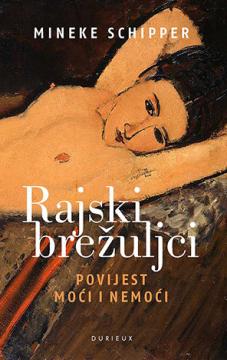
Rajski brežuljci: Povijest moći i nemoći

Rajski brežuljci: Povijest moći i nemoći

Mineke Schipper

In her book, Mineke Schipper explores cultures throughout history to describe the complex relationship men have with the female body. Despite the symbiotic relationship between the sexes, men have always had greater power than women, and at the root of it

Mineke Schipper, a Dutch writer and scholar, explores the cultural history of breastfeeding and the symbolism of the breast across centuries and civilizations. The book, published in 1996 (Croatian translation 2002, Matica hrvatska), analyzes how breasts, as symbols of life, fertility, and sexuality, have shaped social, religious, and artistic narratives, while simultaneously revealing the dynamics of power and powerlessness associated with this part of the body.

Schipper explores the dual role of the breast: as a source of food and a symbol of motherhood, but also as an object of desire and control. Through historical, mythological, and literary examples, from ancient civilizations (Egypt, Mesopotamia) to modern times, she shows how breasts have been celebrated in art and religion (e.g., fertility goddesses), but also subjected to social norms and censorship. She analyzes the role of breastfeeding in different cultures, including taboos, rituals, and medical practices, and how patriarchal systems have often controlled the female body, imposing ideals of beauty or shame.

The book also deals with contemporary contexts, such as the commercialization of breasts in the media and medical debates about breastfeeding versus artificial nutrition. Schipper uses an interdisciplinary approach, combining anthropology, literature and feminist theory, with a rich iconography. The work was praised for its erudition and courage in discussing a taboo subject, but also criticized for occasional generalizations. It offers insight into how cultural constructs shape the perception of the body and gender roles.

Übersetzung
Maja Wiekert
Editor
Ivana Rogar
Maße
20 x 13 cm
Seitenzahl
309
Verlag
Durieux, Zagreb, 2021.
 
Latein Schrift. Fester Einband mit Schutzumschlag.
Sprache: Kroatisch.
ISBN
978-9-53188-478-5

Angeboten wird ein Exemplar

Zustand:Ungebraucht
Zum Warenkorb hinzugefügt!
 

Interessieren Sie sich für ein anderes Buch? Sie können das Angebot über unsere Suchmaschine suchen und finden oder Bücher nach Kategorien durchsuchen.

Diese Titel könnten Sie auch interessieren

Kultura i komunikacija: Logika povezivanja simbola

Kultura i komunikacija: Logika povezivanja simbola

Edmund Leach

In Culture and Communication, Edmund Leach explores social relations through language, rituals, and symbols. He connects anthropology with communication theory, showing culture as a system of meaning that shapes human behavior.

Biblioteka XX vek, 1983.
Serbisch. Latein Schrift. Taschenbuch.
7,32
Kratka povijest ljudske rase

Kratka povijest ljudske rase

Michael Cook

Michael A. Cook, Professor für islamische Geschichte an der Princeton University, gibt in dieser geistreichen und intelligenten Synthese einen Überblick über die Menschheitsgeschichte vom Neolithikum bis zum Einsturz der Twin Towers im Jahr 2001 und stell

Profil Knjiga, 2009.
Kroatisch. Latein Schrift. Taschenbuch.
16,28
Ljudska devolucija: Vedska alternativa Darwinovoj teoriji evolucije

Ljudska devolucija: Vedska alternativa Darwinovoj teoriji evolucije

Michael A. Cremo

The book Human Devolution represents one of the boldest and most comprehensive attempts for modern science to confront its own limits and openly acknowledge the existence of evidence that does not fit into the official story of human origins.

Stari grad, 2007.
Kroatisch. Latein Schrift. Hardcover.
32,54
Orlov dar

Orlov dar

Carlos Castaneda

The sixth book in the series about Castaneda's studies with don Juan Matus, a Yaqui shaman. The novel continues Castaneda's spiritual and philosophical quest, focusing on the concept of the "Eagle's Rule" and the transition to a deeper understanding of sh

BIGZ, 1986.
Kroatisch. Latein Schrift. Taschenbuch.
4,56
Kultura neandertalaca: Čuvari drevne mudrosti

Kultura neandertalaca: Čuvari drevne mudrosti

In this strongly documented book, the British psychologist and researcher claims that Neanderthals were the bearers of an older, more powerful, and spiritually richer culture than Cro-Magnon ("modern" man), and that it was their tradition that formed the

Stari grad, 2006.
Kroatisch. Latein Schrift. Hardcover.
14,22 - 14,28