Honore de Balzac
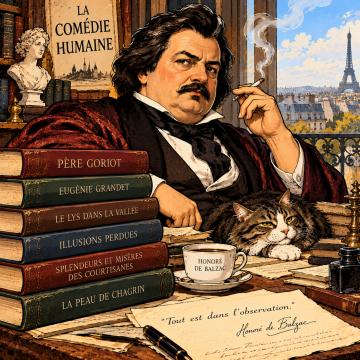
Honoré de Balzac – Bio-bibliography
Honoré de Balzac (Tours, May 20, 1799 – Paris, August 18, 1850) was a French writer and one of the most important figures of European realism. He came from a bourgeois family, studied law in Paris, and briefly worked in law offices, but soon decided to dedicate himself to literature. He published his early novels under pseudonyms and also tried his hand at publishing and printing. Business failures left him with massive debts that plagued him for most of his life.
Balzac was an exceptionally prolific writer, known for his intense work ethic and long nights spent over manuscripts fueled by copious amounts of coffee. His literary ambition was to create a comprehensive portrait of French society in the first half of the 19th century. He linked the majority of his novels and short stories into a monumental cycle titled The Human Comedy (La Comédie humaine), conceived as a kind of literary anatomy of society.
His works feature characters from almost every social stratum—aristocrats, bankers, merchants, civil servants, artists, students, criminals, and the urban poor. A distinctive feature of his literary world is the use of recurring characters across different novels, thereby transforming individual works into parts of a vast, interconnected whole. Among Balzac's most famous works are Father Goriot (1835), Eugénie Grandet (1833), Lost Illusions (1837–1843), Cousin Bette (1846), Cousin Pons (1847), The Splendors and Miseries of Courtesans, The Magic Skin (1831), and The Lily of the Valley (1836). His novels particularly explore the power of money, social advancement, ambition, love, family relationships, and the conflict between the individual and the social order.
In 1850, he married Ewelina Hańska, a Polish noblewoman with whom he had corresponded for years. He died in Paris just a few months after the wedding.
Balzac's ability to observe society precisely, craft psychologically complex characters, and link personal destinies to economic and social circumstances profoundly influenced the development of the modern European novel. His The Human Comedy remains one of the most extensive and ambitious literary projects of the 19th century.
Titles in our offer
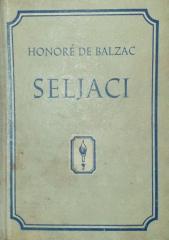
Seljaci
Der Roman Die Bauern (1844) ist eine realistische Darstellung des französischen Landlebens in der ersten Hälfte des 19. Jahrhunderts. Das Buch vermittelt den Eindruck eines tragischen Kampfes zwischen der alten Ordnung und neuen gesellschaftlichen Kräften
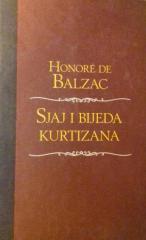
Sjaj i bijeda kurtizana
Glanz und Elend einer Kurtisane ist Teil von Balzacs Sammlung Die menschliche Komödie. Der Roman verfolgt das Schicksal des ehrgeizigen jungen Dichters Lucien de Rubempré und seine Beziehung zum mysteriösen Ex-Sträfling Vautrin in der Welt der Pariser Dek
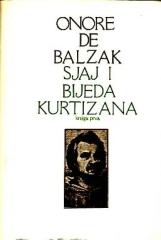
Sjaj i bijeda kurtizana
„Der Glanz und das Elend einer Kurtisane“ ist Teil von Balzacs Sammlung „Die menschliche Komödie“. Der Roman erzählt die Geschichte des ehrgeizigen jungen Dichters Lucien de Rubempré und seine Beziehung zu dem geheimnisvollen Ex-Sträfling Vautrin in der P
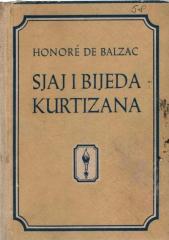
Sjaj i bijeda kurtizana
„Der Glanz und das Elend einer Kurtisane“ ist Teil von Balzacs Sammlung „Die menschliche Komödie“. Der Roman erzählt die Geschichte des ehrgeizigen jungen Dichters Lucien de Rubempré und seine Beziehung zu dem geheimnisvollen Ex-Sträfling Vautrin in der P
Sjaj i bijeda kurtizana
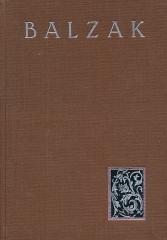

Tri pripovijetke: Župnik od Toursa / Slavni Gaudissart / Tajna kneginje Cadignan
Die Sammlung von drei Kurzgeschichten von Honoré de Balzac präsentiert in der gekonnten Übersetzung und Interpretation von Rudolf Maixner die Werke *Der Pfarrer von Tours*, *Der glorreiche Gaudissart* und *Das Geheimnis der Prinzessin von Cadignan*.
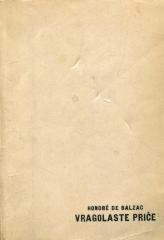
Vragolaste priče
Diese Sammlung umfasst Geschichten wie „Das schöne Reich“, „Die leichte Sünde“, „Die Almosen des Königs“, „Der Erbe des Teufels“, „Der Marschall“ und „Die drei Schriftgelehrten von St.