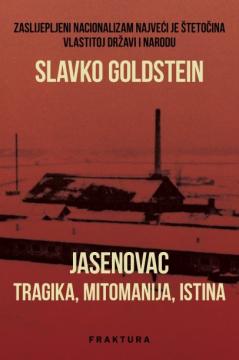
Jasenovac-tragika, mitomanija, istina

Jasenovac-tragika, mitomanija, istina

Slavko Goldstein

Jasenovac - tragedy, mythomania, truth by Slavko Goldstein with a special article by prof. Dr. Ivo Goldstein's "On the number of victims of the Jasenovac camp complex" analyzes all aspects of the Jasenovac camp in an argumentative, accurate and, above all

Jasenovac has been a symbol of the Ustasha camp for seventy-five years, and only then is it thought of as a place. Many books have been written about the Jasenovac concentration camp, and at the end of March 2016, there were 83,145 names on the list of victims prepared by the Jasenovac Public Institution and Memorial Area. Unfortunately, neither that nor numerous testimonies are enough, for the last twenty years there has been a need to diminish or deny the criminal and genocidal nature of the Jasenovac camp. The book Jasenovac – tragedy, mythomania, truth is a polemical and well-argued response to all such attempts. Jasenovac - tragedy, mythomania, truth by Slavko Goldstein with a special article by prof. Dr. Ivo Goldstein's "On the number of victims of the Jasenovac camp complex" analyzes all aspects of the Jasenovac camp in an argumentative, accurate and, above all, precise manner. Jasenovac and his victims cannot and must not be the subject of today's political calculations. Jasenovac is, as Cardinal Stepinac said, "a shameful stain for the NDH", it is a place of special piety, and it can and must be written about without mythomaniac ideas, with an understanding of the tragic fate of individual victims and their families, always and above all having in terms of complete truth.

Editor
Seid Serdarević
Graphics design
Maja Glušić
Dimensions
21 x 14 cm
Pages
156
Publisher
Fraktura, Zaprešić, 2016.
 
Latin alphabet. Hardcover with dust jacket.
Language: Croatian.
ISBN
978-9-53266-709-7

No copies available

The last copy was sold recently.
 

Are you interested in another book? You can search the offer using our search engine or browse books by category.

You may also be interested in these titles

1941. Godina koja se vraća

1941. Godina koja se vraća

Slavko Goldstein

The manuscript of author Slavko Goldstein is much more than memoir literature. It is actually an exceptional depiction of a turning point in recent Croatian history... (I. Banac)

Novi Liber, 2007.
Croatian. Latin alphabet. Hardcover with dust jacket.
28.56
Posljednji dani Hitlera

Posljednji dani Hitlera

Hugh Redwald Trevor-Roper

A study reconstructing the events in Hitler's bunker. The author, a British historian and intelligence officer, was tasked with investigating the circumstances of Hitler's death, debunking the propaganda and rumors that circulated after the fall of the Th

Zora, 1951.
Croatian. Latin alphabet. Paperback with dust jacket.
7.56 - 11.26
Snažan eho brionski: Odjeci Brionskog plenuma u Bosni i Hercegovini 1966. godine

Snažan eho brionski: Odjeci Brionskog plenuma u Bosni i Hercegovini 1966. godine

Amir Duranović

Amir Duranović's book reconstructs in detail the dramatic year 1966 and the Fourth (Brion) Session of the Central Committee of the Communist Party of Yugoslavia (July 1–2, 1966), at which Aleksandar Ranković, the long-time head of the UDB and vice preside

Udruženje za modernu historiju (UMHIS), 2017.
Croatian. Latin alphabet. Paperback.
9.54
Ljubljana u borbi 1941–1945: Zbornik sećanja

Ljubljana u borbi 1941–1945: Zbornik sećanja

The collection brings together the memories of participants in the national liberation struggle in Ljubljana during World War II. The collection contains personal testimonies, which provide insight into the everyday life, struggle and sacrifices of the in

Vojnoizdavački zavod, 1978.
Serbian. Latin alphabet. Hardcover with dust jacket.
9.76
Zaraćeno poraće: Konfliktni i konkurentski narativi o stradanju i iseljavanju Talijana Istre

Zaraćeno poraće: Konfliktni i konkurentski narativi o stradanju i iseljavanju Talijana Istre

Franko Dota

The book analyzes how conflicting historical narratives about the suffering and mass emigration of Italians from Istria and Rijeka developed in Croatia and Italy after World War II (1943–1956), debunking myths and encouraging an empathetic approach to the

Srednja Europa, 2010.
Croatian. Latin alphabet. Paperback.
11.327.92
Staljin : Politička biografija

Staljin : Politička biografija

Isaac Deutscher
Globus, 1977.
Croatian. Latin alphabet. Hardcover with dust jacket.
9.52 - 9.98