Obrtna politika
Antique
Rare book

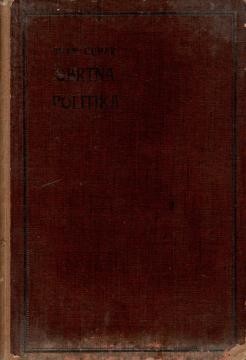
Obrtna politika

Ivan Čupak

A practical and programmatic book on craft policy in Croatia at the end of World War I. Ivan Čupak analyzes the problems, position and prospects of Croatian crafts and proposes measures for their protection and improvement.

Crafts Policy by Ivan Čupak (1918) is a significant professional and journalistic book published at a crucial historical moment – ​​immediately after the end of World War I and the collapse of the Austro-Hungarian Monarchy.

The author, Ivan Čupak (1875–1935?), a bookbinder, secretary of the Association of Croatian Craftsmen and a long-time fighter for the interests of crafts, systematically discusses the difficult situation of Croatian crafts in the new political and economic circumstances. He writes about the need to organize craftsmen, protection from competition, professional training, credit, tax policy and the role of crafts in the future Croatian economy.

The book is written in clear, accessible language and is intended primarily for craftsmen, artisans, their associations and young people. It represents a kind of program manual and appeal for the strengthening of domestic crafts at a time when a new state was being created.

The 1918 edition (VII + 138 pages) is among the rare antiquarian editions. Copies in solid condition are sought after by collectors of economic literature, books on Croatian economic history, and interwar editions. As the author's own edition, the book had a limited circulation and today represents an important historical source for studying crafts and economic conditions in Croatia at the transition from the Austro-Hungarian to the Yugoslav period.

This is a valuable read for lovers of old Croatian journalism, economic history, and those interested in the development of small businesses and crafts in the first half of the 20th century.

Dimensions
22.5 x 15.5 cm
Pages
145
Publisher
Vlastita naklada, Zagreb, 1918.
 
Latin alphabet. Hardcover.
Language: Croatian.

One copy is available

Condition:Used, good condition (visible signs of use)
Damages or inconvenience notice:
  • Worn covers
  • Traces of patina
 

Are you interested in another book? You can search the offer using our search engine or browse books by category.

You may also be interested in these titles

Hrvati koji su stvarali Europu

Hrvati koji su stvarali Europu

Ivan Tanta

The book collects short biographies of thirty Croatians who, through their work in various fields of science, art and society, have made a contribution to European history.

Stari grad, 2003.
Croatian. Latin alphabet. Hardcover.
6.72 - 6.82
Kapucini u Osijeku : gradivo iz bečkog kapucinskog samostana : 1702.-1919.

Kapucini u Osijeku : gradivo iz bečkog kapucinskog samostana : 1702.-1919.

Stjepan Sršan

This book is a valuable resource for anyone interested in the history of Osijek and the role of Capuchins in the development of the city.

Centar Leopold Mandić, 2003.
Croatian. Latin alphabet. Paperback.
6.98
Osječka Tvrđa - Plan obnove i oživljavanja

Osječka Tvrđa - Plan obnove i oživljavanja

This book focuses on the restoration and revitalization plan of the Osijek Fortress, an important historical and architectural site in Osijek.

Urbanistički institut SR Hrvatske, 1976.
Croatian. Latin alphabet. Paperback.
36.98
Anđelko Mijatović: Bleiburška tragedija i križni put hrvatskoga naroda godine 1945.

Anđelko Mijatović: Bleiburška tragedija i križni put hrvatskoga naroda godine 1945.

Anđelko Mijatović

The Bleiburg Tragedy and the Way of the Cross of the Croatian People in 1945 is a historical-documentary work by Croatian historian and university professor Anđelko Mijatović.

HSK, 2007.
Croatian. Latin alphabet. Paperback.
6.62
Povijest Slavonije u sedam požara

Povijest Slavonije u sedam požara

Stanko Andrić
SCPRESS, 1992.
Croatian. Latin alphabet. Paperback.
12.48
Komunizam i čovjek: Odnos vlasti i pojedinca u Hrvatskoj (1958.–1972.)

Komunizam i čovjek: Odnos vlasti i pojedinca u Hrvatskoj (1958.–1972.)

Josip Mihaljević

Josip Mihaljević's book analyzes the relationship between the government and the individual in communist Croatia (1958–1972), through repressive mechanisms, ideological pressures, and restrictions on personal freedom in the socialist system.

Hrvatski institut za povijest, 2016.
Croatian. Latin alphabet. Hardcover.
17.26