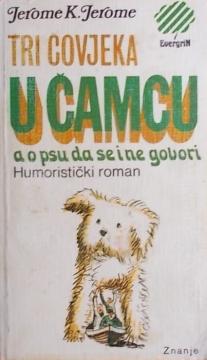
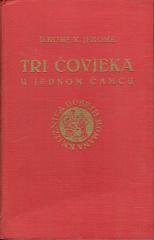
Tri čovjeka u čamcu - a o psu da se i ne govori

Tri čovjeka u čamcu - a o psu da se i ne govori

Jerome K. Jerome
Translation
Nikola Kršić
Editor
Zlatko Crnković
Graphics design
Alfred Pal
Dimensions
19.5 x 12 cm
Pages
210
Publisher
Znanje, Zagreb, 1980.
 
Latin alphabet. Paperback.
Language: Croatian.

No copies available

The last copy was sold recently.
 

Are you interested in another book? You can search the offer using our search engine or browse books by category.

You may also be interested in these titles

Sasvim obične besmislice

Sasvim obične besmislice

Daniil Harms

Ignored and harassed by the authorities, surviving on the help of relatives and publishing children's rhymes, this ingenious marginal left behind a veritable treasure trove of strange stories and twisted thoughts in his notes and notebooks.

Šareni dućan, 1999.
Croatian. Latin alphabet. Paperback.
10.14
Mjesec iznad Splita

Mjesec iznad Splita

Predrag Lucić

Predrag Lucić's second book of poetry, after "The Lovers from Verona" (2007), is a collection of irony, melancholy and contempt for canons - a dedication to the "ridicules" of Split, those who have woven their antics into the city's collective memory.

Algoritam, 2012.
Croatian. Latin alphabet. Paperback.
6.34
Zlatno tele

Zlatno tele

Ilja Iljf, Jevgenij Petrov

The Golden Calf (1931) is a brilliant satirical picaresque adventure, a sequel to the legendary 12 Chairs, where the great schemer Ostap Bender returns in full glory – charming, cynical, irredeemably cunning and always one step ahead of everyone else.

Kultura, 1946.
Croatian. Latin alphabet. Hardcover with dust jacket.
7.56
Who's Who in Hell

Who's Who in Hell

Robert Chalmers

"Who's Who in Hell" (2002) is the debut novel by British journalist and author Robert Chalmers, a comic, provocative and emotional story about love, loss and the absurdities of life.

Atlantic Books, 2003.
English. Latin alphabet. Paperback.
6.74
Pokondirena tikva

Pokondirena tikva

Jovan Sterija Popović

In the comedy Pokondirena tikva, the main character Fema, an ordinary citizen obsessed with the upper class, comically tries to play the role of a lady. The play mocks snobbery, hypocrisy, and the desire for someone else's appearance and manners.

Mladost, 1987.
Serbian. Latin alphabet. Paperback.
6.54
Sabrana djela A. P. Čehova #1: Humoreske

Sabrana djela A. P. Čehova #1: Humoreske

Anton Pavlovič Čehov

This book includes Chekhov's works from 1880-1885, i.e. humoresques, short stories, and sketches, starting with Letters to a Learned Neighbor, which Chekhov considered the beginning of his literary career.

Zora, 1959.
Croatian. Latin alphabet. Hardcover with dust jacket.
9.54