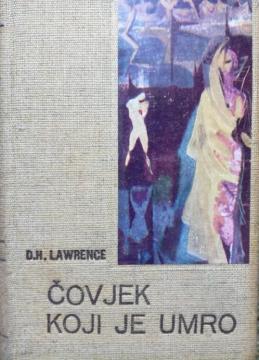
Čovjek koji je umro

Čovjek koji je umro

David Herbert Lawrence
Original title
The Man Who Died
Translation
Mirjana i Dragan Vilke
Graphics design
zdenko Balabanić
Dimensions
20 x 12.5 cm
Pages
295
Publisher
Otokar Keršovani, Rijeka, 1962.
 
Latin alphabet. Hardcover.
Language: Croatian.

One copy is available

Condition:Used, condition good enough
Damages or inconvenience notice:
  • Damaged covers
  • Library stamp
  • Staines on the pages
  • Damaged pages
 

Are you interested in another book? You can search the offer using our search engine or browse books by category.

You may also be interested in these titles

Goropadni eros

Goropadni eros

Georges Bataille, Leszek Kolakowski, Julius Evola, Denis de Rougemont, Michel Foucault, Roland Ba...
Prosveta, 1981.
Serbian. Latin alphabet. Paperback.
9.998.99
Ljubavnik Lady Chatterley

Ljubavnik Lady Chatterley

David Herbert Lawrence

A novel by D.H. Lawrence, published at the author's expense in 1928 in Florence. One of the most controversial novels of the 20th century. It shocked readers at the time with explicit sexual descriptions and language, and was not published in Great Britai

Jutarnji list, 2004.
Croatian. Latin alphabet. Hardcover with dust jacket.
2.66 - 3.36
Ljubavnik ledi Četerli

Ljubavnik ledi Četerli

David Herbert Lawrence
BIGZ, 1990.
Serbian. Latin alphabet. Paperback.
2.99
Deobe

Deobe

Dobrica Ćosić

Deobe is a novel about the tragic division of Serbs into Chetniks and Partisans during World War II. Winner of the NIN Award, it is part of a wider epic trilogy, inspired by Ćosić's experiences and historical documents.

Prosveta, 1963.
Croatian. Latin alphabet. Hardcover with dust jacket.
13.74
Dok ležah na samrti

Dok ležah na samrti

William Faulkner

Faulkner's 1930 novel, a classic example of modernist literature. It is often compared to Joyce's "Ulysses" for its innovative structure, but is more accessible due to its focus on family.

Rad, 1985.
Croatian. Latin alphabet. Paperback.
3.26
Zagrepčanka

Zagrepčanka

Branislav Glumac

Branislav Glumac published a novel without periods or commas in 1974, as the relentless stream of thought of a young rebel. Published in socialist Yugoslavia, the work caused a scandal with its openness and became a classic about generational rebellion.

IROS, 1986.
Croatian. Latin alphabet. Hardcover.
8.22 - 8.24