Filozofija revolucije
Rare book

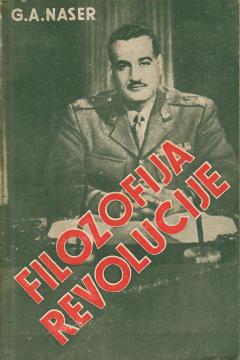
Filozofija revolucije

Gamal Abdel Nasser

G. A. Nasser's Philosophy of Revolution is a political manifesto and ideological program of the Egyptian Revolution of 1952. In it, Nasser explains the motives of the revolution, the role of Egypt in the Arab and African world, and the vision of Arab nati

Philosophy of Revolution is one of the most important works of Gamal Abdel Nasser, the leader of the Egyptian Revolution of 1952 and later President of Egypt. The book was published in 1954/1955 and represents a kind of political testament and ideological foundation of Nasserism.

In the work, Nasser analyzes the causes and goals of the revolution against the monarchy and British influence. He presents Egypt as a country with three circles of identity: Arab, Islamic and African, and emphasizes its historical and geopolitical role as the leader of the Arab world. The book is a mixture of political philosophy, personal reflections and revolutionary rhetoric.

Nasser advocates Arab nationalism, anti-colonialism, social justice and non-alignment in the Cold War division of the world. Of particular importance is the section in which he speaks of the need for strong leadership and the role of the army as the vanguard of the revolution. The style is relatively simple, sometimes pathetic and propagandistic, but very influential in its time.

The work had a huge resonance in the Arab world and became a sort of bible of Arab nationalism and Third World anti-colonialism in the 1950s and 1960s. It was translated into Croatian or Serbian in several editions during the socialist period (especially in the 1960s and 1970s), because Nasser was very popular in Yugoslavia because of the non-aligned movement.

The book remains an important source for understanding Nasserism, Pan-Arabism, and Middle Eastern political thought in the 20th century.

Original title
Falsafat al-Thawra
Translation
Branko Đukić, Abdurahman Hukić
Editor
Miodrag Bogićević
Dimensions
16.5 x 11 cm
Pages
94
Publisher
Džepna knjiga, Sarajevo, 1956.
 
Latin alphabet. Paperback.
Language: Serbian.

One copy is available

Condition:Unused
 

Are you interested in another book? You can search the offer using our search engine or browse books by category.

You may also be interested in these titles

Svi Staljinovi ljudi

Svi Staljinovi ljudi

Roj Medvedev

Roj Medvedev's book is a collection of biographical portraits of six key collaborators of Joseph Stalin: Vyacheslav Molotov, Lazar Kaganovich, Anastasij Mikoyan, Kliment Voroshilov, Georgi Maljenkov and Mikhail Suslov.

Svjetlost, 1987.
Croatian. Latin alphabet. Hardcover.
11.348.50
Nacionalni testament kralja Aleksandra I

Nacionalni testament kralja Aleksandra I

Branislav M. Stepanović

The author presents the political and ideological legacy of King Aleksandar I Karađorđević the Unifier. The book, published immediately after the king's death, is an attempt to preserve and transmit his political ideals to future generations.

Jugoslovenska biblioteka "Bratstvo", 1936.
Serbian. Cyrillic alphabet. Hardcover.
28.36
Povijest #17: Predvečerje rata i drugi svjetski rat

Povijest #17: Predvečerje rata i drugi svjetski rat

The seventeenth volume of the World History series covers the period from 1936 to 1945, focusing on the eve and course of World War II. The book provides a comprehensive account of the war's causes, course, and consequences, including the beginning of the

Europapress holding, 2008.
Croatian. Latin alphabet. Hardcover.
12.32
Povijest #19: Suvremeno doba (1985.-2007.)

Povijest #19: Suvremeno doba (1985.-2007.)

Europapress holding, 2008.
Croatian. Latin alphabet. Hardcover.
9.58
Opet jaše Ku-klux-klan

Opet jaše Ku-klux-klan

Branko Bucalo

The book is written in a lively and sharp style, which - along with a vivid film of facts - continuously keeps the attention of the reader who likes nonfiction full of twists and a certain cynicism imposed by the topic.

Epoha, 1964.
Croatian. Latin alphabet. Hardcover with dust jacket.
6.745.39
Razgovor s poviješću

Razgovor s poviješću

Oriana Fallaci

A Conversation with History is not just a collection of interviews, but also a reflection on history, politics, and human nature. The book exposes the complexities of powerful people and their influence on the world, making it a must-read for history and

August Cesarec, 1979.
Croatian. Latin alphabet. Hardcover with dust jacket.
11.26