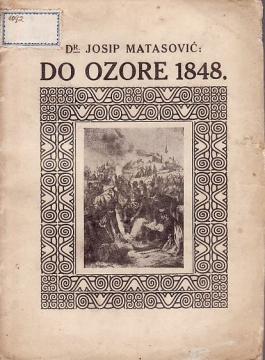
Do Ozore 1848.: Bojni pohod brodskih graničara
Rare book
Antique

Do Ozore 1848.: Bojni pohod brodskih graničara

Josip Matasović

An early work by Croatian historian and archivist Josip Matasović, written when he was about 27. The book is one of his first published works and deals with the military-historical theme of the Revolution of 1848/49 in Croatia.

To Ozora 1848: The Battle of the Brod Border Guards is an early and relatively rare work by Croatian historian and archivist Josip Matasović (1892–1962). The book follows in detail the fate of the Brod (Slavonian) border guards during the Croatian campaign against the Hungarian revolutionary forces in the autumn of 1848.

The work begins with the context of the Revolution of 1848/49, the appointment of Josip Jelačić as ban and the mobilization of the Slavonian border guards from the area of ​​Brod, Vinkovci and the surrounding area. Matasović meticulously reconstructs the recruitment, equipping and march of the regiment through Slavonia, Baranya and southern Hungary all the way to Ozora (present-day Hungary). He pays special attention to the enthusiasm of the border guards, their loyalty to ban Jelačić and Croatian national interests, but also to the real problems – poor equipment, lack of experience, logistical difficulties and the age structure of the unit.

The culmination of the book is the event at Ozora September 11, 1848, known as the surrender of Croatian forces (the so-called Surrender at Ozora). Matasović presents these events from a Croatian perspective, using archival documents, participant reports, and contemporary newspapers. The book ends with an appendix – a polemic by Fran Kurelc against Hungarian accusations against Croatian units.

The style is typical of the time of its creation (immediately after World War I): patriotic, clear, and military-historically precise. Matasović, then a young scholar, demonstrates solid work with sources here, which he would later develop in his cultural-historical studies. The work is an important contribution to the regional history of Slavonia and the study of the role of the Military Border in 1848.

The book contains 7 images and 1 map, which was a solid illustration for that time. Today it is rare in antiquarian books and represents a useful source for researchers of 19th-century Croatian military history.

Dimensions
19.5 x 14.5 cm
Pages
82
Publisher
Dionička tiskara, Zagreb, 1919.
 
Latin alphabet. Paperback.
Language: Croatian.

One copy is available

Condition:Used, very good condition
Specificity of this instance:
Bound
 

Are you interested in another book? You can search the offer using our search engine or browse books by category.

You may also be interested in these titles

Ustav Republike Hrvatske

Ustav Republike Hrvatske

Informator, 1991.
Croatian. Latin alphabet. Paperback.
9.96
U osječkom nutarnjem gradu / In der inneren Stadt von Essek

U osječkom nutarnjem gradu / In der inneren Stadt von Essek

Helena Sablić Tomić
Hrvatska akademija znanosti i umjetnosti (HAZU), 2017.
Croatian. Latin alphabet. Hardcover.
37.46
Povijest sporta grada Osijeka

Povijest sporta grada Osijeka

From the establishment of sports clubs and societies in the city until 1996

Gradsko poglavarstvo grada Osijeka, 1998.
Croatian. Latin alphabet. Hardcover.
19.98
Osječka groblja

Osječka groblja

Stjepan Sršan

The book is deeply rooted in the local history and culture of Osijek, with an emphasis on cemetery motifs that serve as a metaphor for memory, death, and disappearance.

Povijesni arhiv u Osijeku, 1996.
Croatian. Latin alphabet. Paperback.
5.26
Geneza teritorijalne pretenzije Srbije prema Hrvatskoj i kršenje ratnih zakona i običaja tijekom Domovinskog rata od strane agresora

Geneza teritorijalne pretenzije Srbije prema Hrvatskoj i kršenje ratnih zakona i običaja tijekom Domovinskog rata od strane agresora

Ivan Zvonarek
UDNZDR, 2005.
Croatian. Latin alphabet. Paperback.
5.684.54
Kapucini u Osijeku : gradivo iz bečkog kapucinskog samostana : 1702.-1919.

Kapucini u Osijeku : gradivo iz bečkog kapucinskog samostana : 1702.-1919.

Stjepan Sršan

This book is a valuable resource for anyone interested in the history of Osijek and the role of Capuchins in the development of the city.

Centar Leopold Mandić, 2003.
Croatian. Latin alphabet. Paperback.
6.98