Do Ozore 1848.: Bojni pohod brodskih graničara
Antikvitet
Retka knjiga

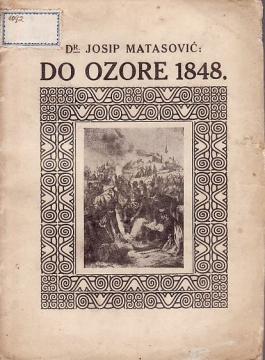
Do Ozore 1848.: Bojni pohod brodskih graničara

Josip Matasović

An early work by Croatian historian and archivist Josip Matasović, written when he was about 27. The book is one of his first published works and deals with the military-historical theme of the Revolution of 1848/49 in Croatia.

To Ozora 1848: The Battle of the Brod Border Guards is an early and relatively rare work by Croatian historian and archivist Josip Matasović (1892–1962). The book follows in detail the fate of the Brod (Slavonian) border guards during the Croatian campaign against the Hungarian revolutionary forces in the autumn of 1848.

The work begins with the context of the Revolution of 1848/49, the appointment of Josip Jelačić as ban and the mobilization of the Slavonian border guards from the area of ​​Brod, Vinkovci and the surrounding area. Matasović meticulously reconstructs the recruitment, equipping and march of the regiment through Slavonia, Baranya and southern Hungary all the way to Ozora (present-day Hungary). He pays special attention to the enthusiasm of the border guards, their loyalty to ban Jelačić and Croatian national interests, but also to the real problems – poor equipment, lack of experience, logistical difficulties and the age structure of the unit.

The culmination of the book is the event at Ozora September 11, 1848, known as the surrender of Croatian forces (the so-called Surrender at Ozora). Matasović presents these events from a Croatian perspective, using archival documents, participant reports, and contemporary newspapers. The book ends with an appendix – a polemic by Fran Kurelc against Hungarian accusations against Croatian units.

The style is typical of the time of its creation (immediately after World War I): patriotic, clear, and military-historically precise. Matasović, then a young scholar, demonstrates solid work with sources here, which he would later develop in his cultural-historical studies. The work is an important contribution to the regional history of Slavonia and the study of the role of the Military Border in 1848.

The book contains 7 images and 1 map, which was a solid illustration for that time. Today it is rare in antiquarian books and represents a useful source for researchers of 19th-century Croatian military history.

Dimenzije
19,5 x 14,5 cm
Broj strana
82
Izdavač
Dionička tiskara, Zagreb, 1919.
 
Latinica. Broširano.
Jezik: Hrvatski.

Jedan primerak je u ponudi

Stanje:Korišćeno, u vrlo dobrom stanju
Specifičnost ovog primerka:
Koričeno
Dodato u korpu!
 

Zanima Vas i neka druga knjiga? Možete pretražiti našu ponudu pomoću pretrage ili prelistati knjige po kategorijama.

Možda će Vas zanimati i ovi naslovi

Ljubav i sjaj: igrokaz u tri čina

Ljubav i sjaj: igrokaz u tri čina

Hermina Tomić

Love and Splendor (1896) by Hermina Tomić is a three-act play published in the Entertainment Library of the Croatian National Library. The work deals with themes of love, social norms, and moral conflicts in bourgeois society at the end of the 19th centur

Matica hrvatska, 1896.
Hrvatski. Latinica. Broširano.
7,36
Izabrana djela

Izabrana djela

Marijan Matijašević, Vlado Vlaisavljević

The collection brings together selected works by Marijan Matijašević and Vlado Vlaisavljević, two different but complementary authors. It brings together lyric poetry, short stories, and dramatic texts that connect intimate poetics, social criticism, and

Matica hrvatska, 2004.
Hrvatski. Latinica. Tvrde korice.
13,58
Drame

Drame

Milutin Cihlar Nehajev

The third volume of Milutin Nehajev's collected works brings together his plays that trace the author's development from youthful enthusiasm to mature introspection: Prielom, Svjećica, Život, Spasitelj and Klupa na mješečini.

Hrvatski izdavalački bibliografski zavod (HIBZ), 1944.
Hrvatski. Latinica. Tvrde korice s omotom.
6,32
Sabrana djela A. P. Čehova #9: Tri sestre i druge drame

Sabrana djela A. P. Čehova #9: Tri sestre i druge drame

Anton Pavlovič Čehov

Since the play Three Sisters was written in the second half of the 19th century, it rightly carries with it certain motifs and an atmosphere that runs through most literary works of that period.

Zora, 1960.
Hrvatski. Latinica. Tvrde korice s omotom.
15,98
Čočara

Čočara

Alberto Moravia

Widow Cesira and her daughter Rosetta flee bombed Rome to their native Ciociaria, where they experience hunger, fear and misery. Liberation brings tragedy: Rosetta is raped by Moroccan soldiers, destroying their faith in God and people.

Otokar Keršovani, 1966.
Hrvatski. Latinica. Tvrde korice.
3,96
Sabrana djela A. P. Čehova #10: Drama bez naslova, Pisma

Sabrana djela A. P. Čehova #10: Drama bez naslova, Pisma

Anton Pavlovič Čehov

The story takes place on a country estate where a group of characters from different social classes gather, faced with boredom, unfulfilled ambitions, and emotional voids.

Zora, 1960.
Hrvatski. Latinica. Tvrde korice s omotom.
13,56