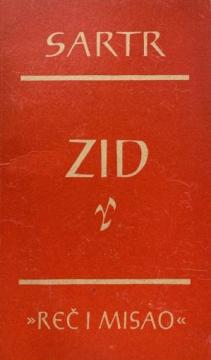

Zid

Zid

Jean-Paul Sartre

"The Wall" is a collection of five existentialist short stories by Jean-Paul Sartre, first published in 1939, which address the absurdity of human existence, freedom, fear, death, and moral choice.

Sartre uses everyday situations and borderline circumstances to explore how man confronts his own freedom, responsibility, and meaninglessness.

The title story, "The Wall," follows three prisoners during the Spanish Civil War awaiting execution. Through psychological tension and the introspective thoughts of the narrator Pablo, Sartre explores how the realization of his inevitable death changes his perspective on life. In a moment of absolute helplessness, Pablo commits an ironic, absurd act that leads to an unexpected twist—showing freedom as the last inner power of man, even in the face of death.

In other stories, such as "Eróstratus" or "Intimacy," Sartre depicts characters struggling with alienation, the body, sexuality, and identity. The common thread in all the stories is the Sartrean view of existence—man is left to himself, without divine help, condemned to freedom and his own choices.

Sartre writes coldly, analytically, and mercilessly. "The Wall" is not just a literary work, but a philosophical illustration of his ideas from Being and Nothingness. The characters in the stories experience moments of crisis that confront them with their own authenticity or cowardice.

"The Wall" remains a seminal work of French existentialism and a powerful portrayal of man's inner struggle for meaning in a world without security.

Original title
Le mur
Translation
Jerka Belan
Graphics design
Janko Krajšek
Dimensions
18 x 10 cm
Pages
118
Publisher
Rad, Beograd, 1964.
 
Latin alphabet. Paperback.
Language: Serbian.

No copies available

The last copy was sold recently.
 

Are you interested in another book? You can search the offer using our search engine or browse books by category.

You may also be interested in these titles

Portreti

Portreti

Jean-Paul Sartre
Nolit, 1981.
Croatian. Latin alphabet. Hardcover with dust jacket.
8.74
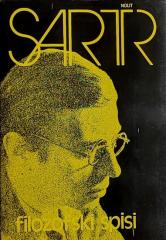
Filozofski spisi

Filozofski spisi

Jean-Paul Sartre
Nolit, 1981.
Serbian. Latin alphabet. Hardcover with dust jacket.
8.56
Prvo šišanje

Prvo šišanje

Bohumil Hrabal

The First Haircut, a short story written in 1970 and published in 1976, is the first in a series of prose pieces by Bohumil Hrabal describing Nymburk, the town where he spent his childhood. In 1981, The First Haircut was adapted for the screen by Jiry Men

24 sata, 2007.
Croatian. Latin alphabet. Paperback.
7.245.43
Gle krasne li paprati

Gle krasne li paprati

Branko Belan

The book "Look How Beautiful the Ferns" by Branko Belan is a collection of short stories set in the Mediterranean milieu, which is characteristic of Belan's literary work.

Alfa, 1978.
Croatian. Latin alphabet. Paperback.
13.26
Sabrana djela A. P. Čehova #3: Drama u lovu i druge novele

Sabrana djela A. P. Čehova #3: Drama u lovu i druge novele

Anton Pavlovič Čehov

The third volume of Collected Works contains Chekhov's most extensive novella, "A Drama in Hunting," as well as a number of longer stories from the period 1885-1886. There are humoresques such as Silo in a Bag, Eh, That Audience, and A Lot of Paper, as we

Zora, 1959.
Croatian. Latin alphabet. Hardcover with dust jacket.
8.74
Knjiga od žena, muškaraca, gradova i rastanaka

Knjiga od žena, muškaraca, gradova i rastanaka

Julijana Matanović

"A Blow to the Psyche", "Hurry Up, My Women", "Oblivion", "The Story of Ivanda", "Shut Up, You're Deaf", are just some of the twelve stories included in the book - to which we always return and always get new answers to long-standing questions.

Mozaik knjiga, 2009.
Croatian. Latin alphabet. Paperback.
7.32