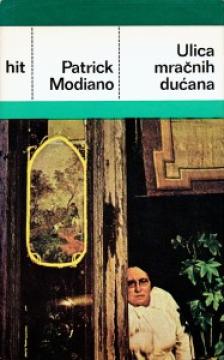
Ulica mračnih dućana

Ulica mračnih dućana

Patrick Modiano

The novel follows Guy Rolland, a detective who suffers from amnesia and tries to discover his own identity. Through an atmospheric and introspective style, Modiano explores the themes of memory, forgetting and the search for oneself in a world that hides

Guy Roland is a private investigator who, in 1965, after his boss retires, decides to undertake his biggest investigation - he wants to find his true identity, discover who he is, because he lost his memory twenty years ago. Following deceptive clues, he discovers that his tragedy occurred during World War II. Meeting various, sometimes obscure, sometimes interesting personalities, little by little he finds pieces of his past, his interrupted and lost life. He discovers his friends and the love of his life, which he cannot find, and his search takes him from Paris and the alpine town of Megeve all the way to Bora Bora, but it seems that he will have to look for the answers to his questions in the Street of Dark Shops, at the address he received in the file about himself at the moment he discovered his real name. Street of Dark Shops by Patrick Modiano, winner of the Nobel Prize for Literature, is a novel in which the themes of this excellent novelist are obsessively revealed – the search for identity, the Second World War and Paris. A street of dark shops is a novel about the search for oneself, about the desire to understand the incomprehensible, to connect the past and the present. Telling an intimate story with impeccable style, Patrick Modiano has written a novel about the drama of each individual.

Original title
Rue des boutiques obscures
Translation
Ana Kolesarić
Editor
Zlatko Crnković
Graphics design
Alfred Pal
Dimensions
20 x 12 cm
Pages
211
Publisher
Znanje, Zagreb, 1980.
 
Latin alphabet. Hardcover with dust jacket.
Language: Croatian.

Multiple copies are available

Copy number 1

Condition:Unused

Copy number 2

Condition:Used, excellent condition

Copy number 3

Condition:Used, excellent condition
Damages or inconvenience notice:
  • Traces of patina
  • Slight damage to the dust jacket
 

Are you interested in another book? You can search the offer using our search engine or browse books by category.

You may also be interested in these titles

Crna lala

Crna lala

Alexandre Dumas

Cornelius van Berle, a young doctor from Dortrecht, is obsessed with creating a black tulip for the prize of the city of Harlem.

Nolit, 1966.
Serbian. Latin alphabet. Hardcover.
2.98
Colomba

Colomba

Prosper Mérimée

Prosper Mérimée's novella, published in 1840, is set in Corsica and explores themes of revenge, honor, and the conflict between the traditional and modern worlds. The novella culminates in a tragic conflict, where love, duty, and violence intertwine.

Zora, 1950.
Croatian. Latin alphabet. Paperback.
2.44 - 2.48
Eugenija Grande

Eugenija Grande

Honore de Balzac

"Eugénie Grandet" (1833), part of Balzac's Human Comedy, is a realistic novel that explores greed, family relationships, and the sacrifices of love in provincial French society.

Svjetlost, 1981.
Croatian. Latin alphabet. Hardcover.
3.88
Filozofske priče

Filozofske priče

Honore de Balzac

Philosophical Tales is part of Balzac's "Human Comedy", and includes four stories – The Shangri-La, The Elixir of Long Life, The Unknown Masterpiece and Melmoth the Penitent – that explore philosophical, moral and metaphysical themes through complex chara

Kultura, 1949.
Croatian. Latin alphabet. Hardcover.
4.22 - 4.25
Megre putuje

Megre putuje

Georges Simenon

"Megre Travels" is a novel that follows the story of the return of Eugène Megre, the famous inspector from the Maigre series of novels, to his native France after a long period of work abroad.

Svjetlost, 1965.
Serbian. Latin alphabet. Paperback.
2.84
Ljubičice u srijedu

Ljubičice u srijedu

Andre Maurois

André Maurois, a French writer known for his psychological novels and biographies, explores themes of family relationships, love, and internal conflicts in this work, which is characteristic of his style.

Svjetlost, 1965.
Croatian. Latin alphabet. Paperback.
3.42 - 3.62