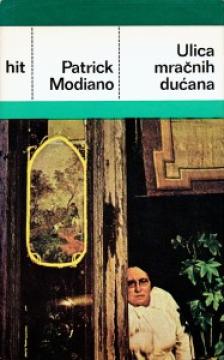
Ulica mračnih dućana

Ulica mračnih dućana

Patrick Modiano

The novel follows Guy Rolland, a detective who suffers from amnesia and tries to discover his own identity. Through an atmospheric and introspective style, Modiano explores the themes of memory, forgetting and the search for oneself in a world that hides

Guy Roland is a private investigator who, in 1965, after his boss retires, decides to undertake his biggest investigation - he wants to find his true identity, discover who he is, because he lost his memory twenty years ago. Following deceptive clues, he discovers that his tragedy occurred during World War II. Meeting various, sometimes obscure, sometimes interesting personalities, little by little he finds pieces of his past, his interrupted and lost life. He discovers his friends and the love of his life, which he cannot find, and his search takes him from Paris and the alpine town of Megeve all the way to Bora Bora, but it seems that he will have to look for the answers to his questions in the Street of Dark Shops, at the address he received in the file about himself at the moment he discovered his real name. Street of Dark Shops by Patrick Modiano, winner of the Nobel Prize for Literature, is a novel in which the themes of this excellent novelist are obsessively revealed – the search for identity, the Second World War and Paris. A street of dark shops is a novel about the search for oneself, about the desire to understand the incomprehensible, to connect the past and the present. Telling an intimate story with impeccable style, Patrick Modiano has written a novel about the drama of each individual.

Original title
Rue des boutiques obscures
Translation
Ana Kolesarić
Editor
Zlatko Crnković
Graphics design
Alfred Pal
Dimensions
20 x 12 cm
Pages
211
Publisher
Znanje, Zagreb, 1980.
 
Latin alphabet. Hardcover with dust jacket.
Language: Croatian.

Multiple copies are available

Copy number 1

Condition:Unused

Copy number 2

Condition:Used, excellent condition

Copy number 3

Condition:Used, excellent condition
Damages or inconvenience notice:
  • Traces of patina
  • Slight damage to the dust jacket
 

Are you interested in another book? You can search the offer using our search engine or browse books by category.

You may also be interested in these titles

A što ako vrijeme ne postoji?

A što ako vrijeme ne postoji?

Carlo Rovelli

Ten years before he discovered the theory of general relativity, Einstein realized that time and space were not two separate entities, but two aspects of one and the same entity.

Tim press, 2015.
Croatian. Latin alphabet. Paperback.
6.785.09
Stranac

Stranac

Albert Camus

"The Stranger" (1942) by Albert Camus, a classic work of existentialism, follows the life of Meursault, an emotionally indifferent Algerian of French descent, whose apathetic attitude towards the world leads to tragic consequences.

Zora, 1951.
Croatian. Latin alphabet. Paperback.
13.46
Moloa

Moloa

Samuel Beckett

The novel Molloy (1951) is the first part of Beckett's famous trilogy, along with Malone Dies and The Nameless. It is structured in two parts, each told from the perspective of a different narrator: first Molloy, then Jacques Moran.

Kosmos, 1959.
Serbian. Latin alphabet. Hardcover.
8.46
Čovek od gipsa

Čovek od gipsa

Joseph Kessel

The novel, whose original title is L'Homme de plâtre, explores complex human destinies through the story of a protagonist whose life symbolically reflects fragility and vulnerability, like plaster.

Minerva, 1987.
Serbian. Latin alphabet. Hardcover.
4.64
Čiča Gorio

Čiča Gorio

Honore de Balzac

Uncle Goriot is the story of the old war profiteer Goriot and his daughters, who, after robbing him to the point of being naked, leave him to die in the solitude and misery of the Vaquer boarding house. It is a story that can be read today on several leve

Veselin Masleša, 1971.
Serbian. Latin alphabet. Hardcover with dust jacket.
52.36 (set)
Taida: roman iz aleksandrijskih vremena

Taida: roman iz aleksandrijskih vremena

Anatole France

The novel Taida, published in 1890, is one of the most famous works by French Nobel Prize winner Anatole France. The work is inspired by the legend of Saint Taida of Egypt, a 4th-century courtesan who converted to Christianity.

Rad, 1961.
Serbian. Latin alphabet. Paperback.
1.99