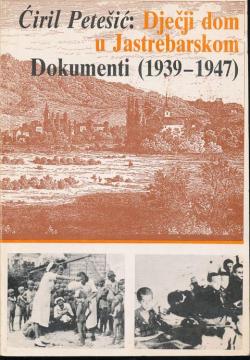
Dječji dom u Jastrebarskom: Dokumenti (1939-1947.)

Dječji dom u Jastrebarskom: Dokumenti (1939-1947.)

Ćiril Petešić

The book focuses on the period when a children's camp existed in Jastrebarsko for children brought from the Stara Gradiška camp and other Jasenovac camps, from July 12th to the beginning of November 1942.

The reason for this is that a large number of articles, feuilletons, and several books were devoted to this period in our post-war press, but no critical account of the events was given. Another reason is that the most important documents were not published in their entirety. Some of them, if they were quoted, were used for the purpose of a particular discussion or book, but not those parts of the documents that give things a noticeably different light. The third reason is that numerous "memories" were published, created 30-40 years after the events in Jastrebarski during the Second World War. "Memories" were published mostly in fragments, and they are nevertheless second-rate (secondary) documents. For these reasons, I tried to pay as much attention as possible to the publication of the primary documents in their entirety, and in this respect, in my opinion, the value of this book lies. Until now, readers have not had the opportunity to notice that the short history of the children's home in Jastrebarski had several phases: pre-war, when Banovina Hrvatska founded its home for orphans, initial wartime, until the camp for children from the Jasenovac camps was added to the children's home, which existed for almost 4 months, a further phase until the end of the war and a post-war phase. The establishment of a children's infectious disease hospital was particularly significant, which continued to operate as an epidemic hospital after the end of the children's camp. In addition, there were actually three children's homes in Jastrebarski, and they were state children's homes, under the care and supervision of the Banovina Hrvatska, the Ministry of the NDH and after the war the Republic of Croatia.

Graphics design
Martina Petek Stupar
Dimensions
24 x 17 cm
Pages
212
Publisher
Kršćanska sadašnjost, Zagreb, 1990.
 
Distribution: 1,200 copies
 
Latin alphabet. Paperback.
Language: Croatian.
ISBN
8-63-970084-2

No copies available

The last copy was sold recently.


Are you interested in another book? You can search the offer using our search engine or browse books by category.

You may also be interested in these titles

Hrvatsko proljeće

Hrvatsko proljeće

Miko Tripalo

The Croatian Spring is not only a chronicle of the events of 1971, but also a suggestive presentation of the political conditions of Yugoslavia in the post-war period. These testimonies come from the pen of a man who really tried to break the shackles of

Globus, 1990.
Croatian. Latin alphabet. Hardcover with dust jacket.
11.5810.02 - 13.3611.58
Živjeti u Hrvatskoj: Zapisci iz nepovrata 1900 - 1941.

Živjeti u Hrvatskoj: Zapisci iz nepovrata 1900 - 1941.

Horvat
Josip Horvat

The book represents a personal chronicle of Croatian history in the first half of the 20th century, written by Josip Horvat with the intention of documenting the social, political, and cultural changes that shaped Croatia between 1900 and 1941.

Sveučilišna naklada Liber (SNL), 1984.
Croatian. Latin alphabet. Hardcover with dust jacket.
17.24
U osječkom nutarnjem gradu / In der inneren Stadt von Essek

U osječkom nutarnjem gradu / In der inneren Stadt von Essek

Helena Sablić Tomić
Hrvatska akademija znanosti i umjetnosti (HAZU), 2017.
Croatian. Latin alphabet. Hardcover.
37.46
Branimirova Hrvatska u pismima pape Ivana VIII.

Branimirova Hrvatska u pismima pape Ivana VIII.

Mate Zekan
Književni krug, 1989.
Croatian. Latin alphabet. Paperback.
4.39
Zapisnici grada Osijeka 1861.-1866.

Zapisnici grada Osijeka 1861.-1866.

Stjepan Sršan

Material for the history of Osijek and Slavonia

Državni arhiv u Osijeku, 2004.
Croatian. Latin alphabet. Paperback.
11.327.92
Eseji i članci

Eseji i članci

Ljubo Karaman

The collection Essays and Articles by Ljubo Karaman, an eminent art historian, includes a series of texts on Croatian art, with an emphasis on the medieval heritage of Dalmatia and its connection with European cultural movements.

Matica hrvatska, 1939.
Croatian. Latin alphabet. Hardcover.
10.347.76