Josif S. Šklovski
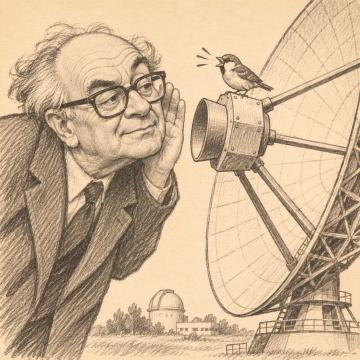
Iosif Samuilovich Shklovsky (Hlukhiv, 1916 – Moscow, 1985) wondered whether someone out in space might get in touch by radio. First there was the small matter of getting to know a universe that was already broadcasting on more frequencies than anyone would want on a kitchen radio. Shklovsky knew that an odd signal could have an entirely natural source. Sometimes the source turns out to be more interesting than the message you were hoping for.
The Soviet astrophysicist studied the solar corona, supernovae and radio waves from space. His best-known scientific work concerned the Crab Nebula, the remnant of a stellar explosion. He explained its radiation by showing what happens when very fast electrons move through a magnetic field. He also studied the 21-centimetre radio line of neutral hydrogen before it was first observed. That line let astronomers trace hydrogen in parts of the Milky Way hidden by dust. Where an optical telescope has its view blocked, a radio astronomer can still find plenty to listen to.
For general readers, Shklovsky is best known for Вселенная, жизнь, разум (Universe, Life, Intelligence, 1962). The 1989 Belgrade edition, published by Prosveta as Vasiona, život, razum, includes commentary by physicist Vladan Čelebonović. American astronomer Carl Sagan helped expand the Russian book, and the English version appeared under both their names in 1966 as Intelligent Life in the Universe. Shklovsky also wrote specialist books on the solar corona and supernovae. Here he writes for anyone curious about how to turn “Are we alone?” into a question we can investigate.
The book brings astronomy and biology together. Where might life arise? And how might we recognise a sign of civilisation too far away to visit? Shklovsky makes the search itself worth following. First you have to decide what to listen for, and if something does come through, it’s worth checking that it really came from the direction you pointed the antenna.
Naslovi u ponudi

Vasiona, život, razum
How do planets form, where might life arise, and how would we recognise a signal from another civilisation? Astrophysicist Iosif Shklovsky explores what astronomy can tell us about these questions.