Marianne Westerlind

Marianne Westerlind hasn’t finished her sentence before Mozart steps onto the manuscript and raises a finger. Apparently he’d like a say in how he ends up in the novel Besmrtni Mozart.
Marianne Westerlind was a pen name of Clara Brockmann (Gadebusch, 1883 – Hamburg, 1955), a German writer and journalist who also used the name Marianne Brockmann. From 1907 to 1911 she lived in what was then German South West Africa, now Namibia, and worked in the governor’s office in Windhoek. Her years there shaped her first books, Die deutsche Frau in Südwestafrika (1910) and Briefe eines deutschen Mädchens aus Südwest (1912).
Under the name Westerlind she published Du heiliges Land! (1914), a novel likewise set in colonial south-western Africa. These early works show how German colonial literature imagined the role of women settlers. Brockmann herself advocated the migration of German women to the colony, and her books also bear witness to the attitudes that accompanied colonial rule.
Her later work ranged across subjects and forms of publication. Das Heiratsgesuch appeared as a book in 1919, while Der Flug zur Sonne was serialised in the Viennese periodical Die Frau in 1921.
Her fictionalised biography Besmrtni Mozart (Unsterblicher Mozart, 1938) appeared in Croatian in a translation by Slavko Batušić, published in Zagreb in 1941 by Nakladni zavod Jos. Čaklović. In the book, the composer’s life becomes the material for a novel. The Croatian edition was one of several fictionalised lives of composers published in Zagreb in the early 1940s that brought music history to a wider readership through the stories of individual lives.
Naslovi u ponudi
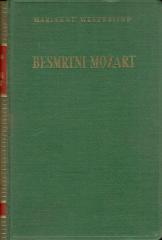
Besmrtni Mozart
A biographical novel that follows the life of Wolfgang Amadeus Mozart, highlighting his artistic genius, struggle with poverty, and the relationships that shaped his art and destiny.