Dante Alighieri
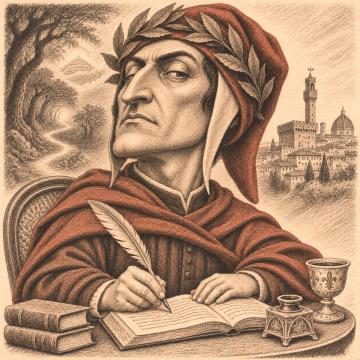
Dante Alighieri (1265–1321) loses his way in a dark wood in The Divine Comedy (Commedia, now Divina Commedia). His guide promptly leads him down through all nine circles of Hell. You can trust Virgil on matters of poetry. On matters of shortcuts, you might want to ask how far down you’ll have to go before the road starts climbing again.
Dante was born in Florence, took part in its political life and served as one of the city’s priors in 1300. After a rival faction took power, he was sentenced to exile in 1302. He never returned to Florence and died in Ravenna. In his early La vita nuova (The New Life), poems inspired by Beatrice are linked by prose that explains how they came to be and what they meant to him. Beatrice returns in the Comedy as his guide through Paradise. A good part of Dante’s life as a poet lies between the first meeting and the reunion.
In exile he wrote the unfinished Convivio (The Banquet), adding philosophical commentaries to his own poems, and the Latin treatise De vulgari eloquentia, on what the vernacular could do as a literary language. He wrote the Comedy in that vernacular, drawing on the speech of Florence. Its three parts, Inferno, Purgatorio and Paradiso, run to a hundred cantos. Virgil guides him through Hell and most of Purgatory. With Beatrice he continues towards Heaven.
Along the way Dante meets heroes from antiquity, people from his own time and some whose names might have vanished without his verse. Francesca da Rimini speaks of love and the book she was reading with Paolo. Ulysses tells of a desire for knowledge that carried him farther than he was meant to go. An encounter can make you stop just when you were keen to see what the next circle held. Virgil’s job, after all, is to show the way. How long we spend with each story is up to us.
Titel im Angebot

Pakao
Inferno is an epic poem that belongs to Dante's greatest work, the Divine Comedy. He began writing it around 1307 and finished it shortly before his death in 1321.