Aleksandar S. Puškin
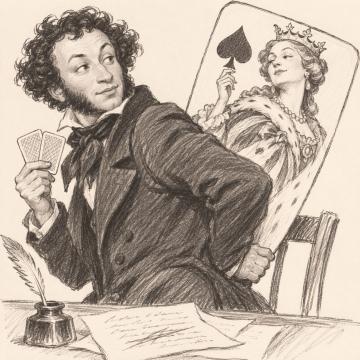
Alexander Sergeyevich Pushkin (1799–1837) knew how much damage one card could do to a well-laid plan. The protagonist of The Queen of Spades is sure that three cards are all he needs to make his fortune. The first two do indeed go his way. The third shows what can happen when you’re certain, in advance, of what you’re holding. Pushkin needed only a short story to get him into that much trouble.
Born in Moscow, Pushkin attended the lycée at Tsarskoye Selo near St Petersburg. His poems about liberty and criticism of the authorities led to exile in the south of the Russian Empire, followed by a period of enforced residence at his family estate, Mikhailovskoye. Ruslan and Lyudmila (Руслан и Людмила, 1820) drew attention with its blend of fairy tale, adventure and a narrator who reserves the right to crack a joke. In the historical drama Boris Godunov (Борис Годунов, published 1831), Pushkin asks what good it does to gain a throne if questions about how you got there follow you even when you’re alone.
Eugene Onegin (Евгений Онегин, first complete edition 1833) is a novel in verse about people who realise the right thing at the wrong time. Tatyana writes to Onegin while he still thinks he prizes his freedom above love. When he finally changes his mind, he has to hear what she thinks. The narrator digresses about friends, fashion and books, as though offering you a seat at his table along with the story. In prose Pushkin could be much more economical. The Tales of Belkin (Повести Белкина, 1831) show how much of a life can come through in a handful of scenes. The Queen of Spades (Пиковая дама, 1834) shows how quickly calculation can become obsession.
In The Captain’s Daughter (Капитанская дочка, 1836), Pushkin sets the fortunes of a young officer and the woman he loves against Pugachev’s rebellion. That same year he founded the literary journal Sovremennik (Современник). He died in St Petersburg in 1837 from wounds suffered in a duel. His characters often think they can still choose when to make their decisive move. The reader usually spots a little sooner that it’s already their turn.
Titles in our offer

Bajke: Bajka o ribaru i ribici / Priča o popu i njegovu radniku Baldi
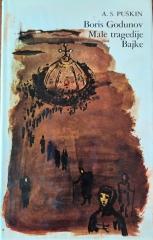
Boris Godunov Male tragedije Bajke
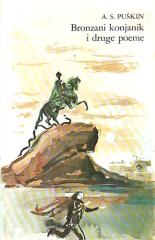
Bronzani konjanik i druge poeme

Izabrana djela, sv. I.: Dramske slike i poeme
Prvi svezak Puškinovih izabranih djela donosi dramske slike i poeme: od prizora iz Fausta i Mozarta i Salierija do Brončanog konjanika i Poltave, spajajući dramu, liriku i povijest.
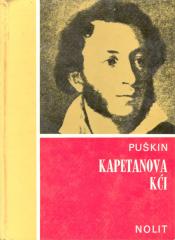
Kapetanova kći
Kapetanova kći je povijesni roman ruskog pisca Aleksandra Puškina. Prvi put je objavljena 1836. u četvrtom broju književnog časopisa Sovremennik. Roman je romantizirani prikaz Pugačovljeve pobune 1773–1774.

Kapetanova kći i druga djela
Zbirka okuplja Puškinovu liriku i prozu, od intimnih pjesama do pripovijedaka i romana Kapetanova kći, prikazujući širinu njegova talenta, stilsku eleganciju i trajnu književnu snagu.