Lajos Zilahy
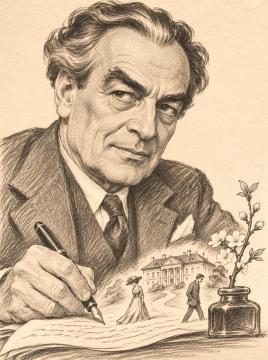
What remains of intimacy when war separates two people and both have to rebuild their lives? That question lies at the heart of Két fogoly (1926), a novel by Lajos Zilahy (1891–1974). The war is felt in the waiting, in the uncertainty and in the fear that the person you long to see may come back almost a stranger. Zilahy is especially convincing when he shows such changes through the eyes of people who are only beginning to sense them.
He was born in Nagyszalonta, now Salonta in Romania. He studied law and worked as a lawyer before devoting himself to literature in the early 1920s. He wrote novels, plays and screenplays. From 1947 he lived in the United States, and he spent his final years in Yugoslavia. He died in Novi Sad.
Zilahy found a wide readership with Halálos tavasz (1922), a novel in which the exhilaration of love gradually turns to despair. It was translated into several languages and adapted into a Hungarian film in 1939. In Valamit visz a víz (1928), he returns to the power of passion, while A fegyverek visszanéznek (1936) revisits the consequences of war.
The family saga A Dukay család (1968) gives this story of change a broader setting. In Ararát and the other parts of the saga, marriages, family quarrels and attempts to hold on to rank reveal how the Hungarian aristocracy loses the security on which it built its world. Zilahy writes about his characters with sympathy and treats their privileges and their sense of their own importance with gentle irony.
From Halálos tavasz to A Dukay család, the scale shifts from a love affair to the fate of a family. What remains is Zilahy’s gift for showing how change is first felt in ordinary life: in a meeting that no longer goes as it once did, in a decision put off, or in the hope that coming home will allow life to pick up where it left off.
