Osvaldo Ramous
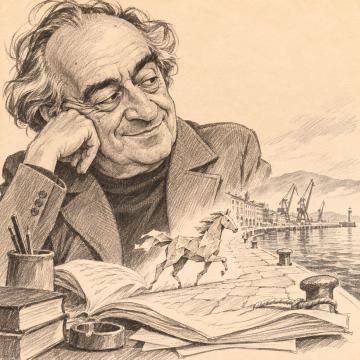
Osvaldo Ramous (Rijeka, 1905 – Rijeka, 1981) was born and died in the same city, but that city changed hands several times during his lifetime. In Il cavallo di cartapesta (Papirnati konj in Croatian), he looks at Rijeka’s history up close, through people who see their daily lives change, their neighbours leave and Italian, the language in which he wrote, lose its former place in public life.
He published his first poems in the Rijeka magazine Delta in 1923. The influence of Gabriele D’Annunzio is apparent in Nel canneto (1938), particularly in the imagery and sound of the verse. In later collections such as Pianto vegetale (1957) and Risveglio di Medea (1967), his voice becomes more restrained and reflective. The bilingual 50 poesie – 50 pjesama (1957) allowed readers to encounter his verse in Italian and Croatian side by side.
The theatre in Rijeka was central to his working life. He was a resident director, led the Italian Drama company and served as the theatre’s deputy general director. He also wrote short stories, radio plays and criticism. As a translator and editor, he helped other writers reach new readers. In 1959, he edited Poesia jugoslava contemporanea, an anthology of contemporary Yugoslav poetry in Italian published in Padua.
His novels reached readers by different routes. I gabbiani sul tetto first appeared in Portuguese in Brazil in 1964, followed by the Croatian translation, Galebovi na krovu, in Zagreb in 1965. His short-story collection Lotta con l’ombra e altri racconti appeared posthumously in 2006.
Il cavallo di cartapesta waited about forty years for publication. Gianna Mazzieri-Sanković edited the first Italian edition, published in Rijeka in 2007. The Croatian translation, Papirnati konj, appeared in 2023 in the series Istra kroz stoljeća. The novel returns to a question that marked Ramous’s life: what does it mean to belong to a city that is changing before your eyes?
Titles in our offer

50 pjesama
Pedeset pesama Osvalda Ramousa otkriva intimni svet ljubavi, samoće, prolaznosti i ljudske sudbine. Lirski glas italijanske književnosti Rijeke u hrvatskom prevodu Danka Anđelinovića.