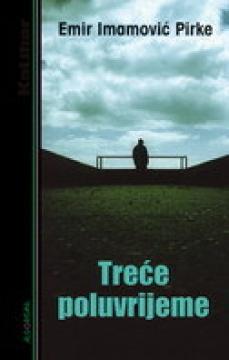
Treće poluvrijeme

Treće poluvrijeme

Emir Imamović-Pirke

The third book by Emir Imamović Pirke, The Third Half, tells the story of a typical socialist settlement built around a barbed wire factory, and of the post-war ruin of that town and its population.

The novel begins with a TV news report about the discovery of three corpses in the Duboka pit above Podgrad, and through a series of flashbacks, it narrates a story that goes back to pre-war times and which, at the end of the novel, will solve the enigma of their murder. Pirka skillfully and unmistakably manages the complex and comprehensive plot, to the benefit of the story. The third half is a novel whose crime story was created on the basis of private dramas, conceived somewhere, in the historical and political and psychological and football fields. In short, everything in one place, neither town nor village, but in Podgrad.

Editor
Neven Antičević
Dimensions
22 x 14 cm
Pages
231
Publisher
Algoritam, Zagreb, 2010.
 
Distribution: 1,000 copies
 
Latin alphabet. Hardcover.
Language: Croatian.
ISBN
978-9-53316-257-7

No copies available

The last copy was sold recently.
 

Are you interested in another book? You can search the offer using our search engine or browse books by category.

You may also be interested in these titles

Dijalektika prijelaznog perioda

Dijalektika prijelaznog perioda

Viktor Pelevin

The book represents the author's anthology - the largest part is the novel Čisla (Čisla), followed by the short story Macedonian Criticism of French Thought and several short stories (Odin vog, Akiko, Fokus-grupa, Gost na prazniku bon).

Disput, 2006.
Croatian. Latin alphabet. Paperback.
9.68
Nema slonova u Meksiku

Nema slonova u Meksiku

Zoran Pilić

Ove priče će nas nasmejati, ali i neprimetno odvesti na drugu, mračnu stranu...

Fraktura, 2014.
Croatian. Latin alphabet. Hardcover with dust jacket.
6.98
Danteov trg

Danteov trg

Dragan Velikić

Wie schon in Velikićs früheren Romanen verweben die Helden analoge und oft miteinander verwobene Schicksale frustrierter mitteleuropäischer Bürger und Intellektueller; die Topographie ist sehr vielfältig, aber dennoch wiedererkennbar.

Stubovi kulture, 1998.
Serbian. Latin alphabet. Paperback.
6.72
Kuća u kojoj stanuje vrag

Kuća u kojoj stanuje vrag

Goran Tribuson

In „Das Haus, in dem der Teufel wohnt“ thematisiert Tribuson auch die Zeit der neuen Armut, verrückte Scherze auf dem Weg zum Geldverdienen, Wucher, Eifersucht, Rache, Streiks und Morde.

Znanje, 2006.
Croatian. Latin alphabet. Paperback.
7.87
Ruski prozor

Ruski prozor

Dragan Velikić

Die vielleicht größte Stärke von Velikićs Schreiben, die in diesem Roman ihren Höhepunkt fand, ist sein außerordentlich feines Gespür für die Details des Lebens, die er mit einer fast schamanischen Kraft der Materialisierung schildert und heraufbeschwört.

Profil International, 2008.
Croatian. Latin alphabet. Paperback.
6.98
V.

V.

Thomas Pynchon

The novel represents a journey into an alternative world – a world that we all belong to from time to time, but of which we would not want to be a part, a world of paranoia and alienation that we are not entirely sure is just an alternative or the bare tr

Čarobna knjiga, 2010.
Serbian. Latin alphabet. Paperback.
21.9819.78