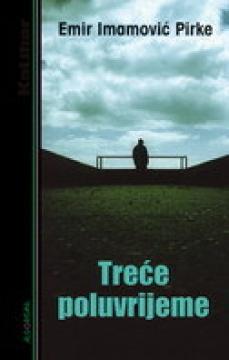
Treće poluvrijeme

Treće poluvrijeme

Emir Imamović-Pirke

The third book by Emir Imamović Pirke, The Third Half, tells the story of a typical socialist settlement built around a barbed wire factory, and of the post-war ruin of that town and its population.

The novel begins with a TV news report about the discovery of three corpses in the Duboka pit above Podgrad, and through a series of flashbacks, it narrates a story that goes back to pre-war times and which, at the end of the novel, will solve the enigma of their murder. Pirka skillfully and unmistakably manages the complex and comprehensive plot, to the benefit of the story. The third half is a novel whose crime story was created on the basis of private dramas, conceived somewhere, in the historical and political and psychological and football fields. In short, everything in one place, neither town nor village, but in Podgrad.

Editor
Neven Antičević
Dimensions
22 x 14 cm
Pages
231
Publisher
Algoritam, Zagreb, 2010.
 
Distribution: 1,000 copies
 
Latin alphabet. Hardcover.
Language: Croatian.
ISBN
978-9-53316-257-7

No copies available

The last copy was sold recently.
 

Are you interested in another book? You can search the offer using our search engine or browse books by category.

You may also be interested in these titles

Klatno

Klatno

György Konrád

Pendulum draws an inner map of the adventure of self-disclosure - of one's own inclinations, fears, desires, Love - one's own habitus, revealing, as never before, the secrets of the writer's workshop.

Kulturni centar Novog Sada, 2010.
Serbian. Latin alphabet. Paperback.
6.24
Deobe

Deobe

Dobrica Ćosić

Deobe is a novel about the tragic division of Serbs into Chetniks and Partisans during World War II. Winner of the NIN Award, it is part of a wider epic trilogy, inspired by Ćosić's experiences and historical documents.

Prosveta, 1963.
Croatian. Latin alphabet. Hardcover with dust jacket.
13.74
Usta puna zemlje

Usta puna zemlje

Branimir Šćepanović

The novel "Usta puna zemlje" (1970), the masterpiece of the Serbian writer Branimir Šćepanović, is a psychologically in-depth explorer of the limits of the human soul, solitude and existential freedom, reminiscent of Kafka and Camus.

BIGZ, 1987.
Serbian. Latin alphabet. Paperback.
3.98
Magična ljubavna kutijica

Magična ljubavna kutijica

Santa Montefiore

The Magic Love Box (2002) follows the life story of Federica Campione, which begins in Vina del Mar, Chile, in the summer of 1982. Montefiore creates an epic story of growth, where the magic is not only in the box, but in the courage to let go of the past

Mozaik knjiga, 2006.
Croatian. Latin alphabet. Hardcover.
7.34
Zagrepčanka

Zagrepčanka

Branislav Glumac

Branislav Glumac published a novel without periods or commas in 1974, as the relentless stream of thought of a young rebel. Published in socialist Yugoslavia, the work caused a scandal with its openness and became a classic about generational rebellion.

IROS, 1986.
Croatian. Latin alphabet. Hardcover.
8.22 - 8.24
Dok ležah na samrti

Dok ležah na samrti

William Faulkner

Faulkner's 1930 novel, a classic example of modernist literature. It is often compared to Joyce's "Ulysses" for its innovative structure, but is more accessible due to its focus on family.

Rad, 1985.
Croatian. Latin alphabet. Paperback.
3.26