Sto godina samoće
Ein rares Buch

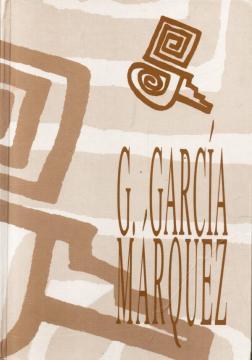
Sto godina samoće

Gabriel Garcia Marquez

The novel is one of the most important works of Latin American literature of the 20th century and a key representative of magical realism, a genre in which everyday events are combined with surreal and fantastical elements.

The novel "One Hundred Years of Solitude" follows the Buendía family, founded by José Arcadio Buendía, through seven generations, beginning with his founding of the desert town of Macondo, and continuing through the following decades. Through the story of this family, which, like the city of Macondo, is in a sense "sealed by fate", Marquez explores the themes of time, transience, history, love, death and self-destructive cycles that repeat themselves through generations.

The main part of the novel follows the life of José Arcadia Buendía and his descendants, who are always faced with problems that come from their past mistakes, unrequited loves and the constant search for the meaning of existence. All members of the Buendia family, despite their individual characteristics, share similar fates – they are lonely, cursed to repeat the same mistakes through the generations, and often face personal and family tragedies.

One of the key motifs in the novel is loneliness, which pervades all the characters and their fate. Despite living in a community, the characters are emotionally isolated and often experience an inner emptiness, which leads to the repetition of their mistakes and misfortunes across generations.

In addition, "One Hundred Years of Solitude" also deals with the issue of history and time, through the cyclical repetition of events, which implies that people cannot escape from past mistakes, nor can they avoid their fate. Magical realism is present in every part of the novel – surreal phenomena, such as flying and unusual events, are accepted as a normal part of everyday life.

Titel des Originals
Cien años de soledad
Übersetzung
Nikola Milićević
Editor
Milivoj Telećan
Titelseite
Dubravka Zglavnik
Maße
20 x 14 cm
Seitenzahl
370
Verlag
Školska knjiga, Zagreb, 1995.
 
Latein Schrift. Taschenbuch.
Sprache: Kroatisch.
ISBN
978-9-53060-626-5

Im Angebot sind keine Exemplare vorhanden

Das letzte Exemplar wurde kürzlich verkauft.
 

Interessieren Sie sich für ein anderes Buch? Sie können das Angebot über unsere Suchmaschine suchen und finden oder Bücher nach Kategorien durchsuchen.

Diese Titel könnten Sie auch interessieren

Neverovatna i tužna istorija nevine Erndire i njene bezdušne babe: sedam priča

Neverovatna i tužna istorija nevine Erndire i njene bezdušne babe: sedam priča

Gabriel Garcia Marquez
Dečje novine, 1979.
Kroatisch. Latein Schrift. Taschenbuch.
2,99
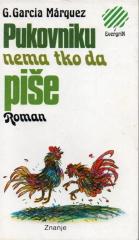
Pukovniku nema tko da piše

Pukovniku nema tko da piše

Gabriel Garcia Marquez

The Colonel Has No One to Write to by Gabriel García Márquez is a story about an old colonel who has been waiting for years for his promised state pension. In poverty and uncertainty, he refuses to lose hope.

Znanje, 1982.
Kroatisch. Latein Schrift. Taschenbuch.
4,86
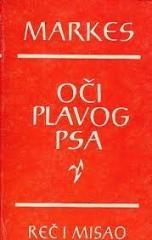
Oči plavog psa

Oči plavog psa

Gabriel Garcia Marquez
Izdavačko preduzeće "Rad", 1979.
Serbisch. Latein Schrift. Taschenbuch.
3,98
Hitar kao žudnja

Hitar kao žudnja

Laura Esquivel

This sensual and emotional story explores the complex relationships of love, communication, and family ties through the life story of Júbilo, a man gifted with the exceptional gift of understanding and conveying emotions.

Algoritam, 2005.
Kroatisch. Latein Schrift. Taschenbuch.
3,24
Dvanaest hodočasnika

Dvanaest hodočasnika

Gabriel Garcia Marquez

The twelve stories in this book were written over the past eighteen years. Before taking on their current form, five of them were adapted into newspaper articles and film scripts, and one into a television series.

Ceres, 1998.
Kroatisch. Latein Schrift. Taschenbuch.
6,34
Quattrocento

Quattrocento

Susana Fortes

A double story: Florence 1478, the Pazzi conspiracy against the Medici. In the 21st century, student Ana Sotomayor investigates Renaissance painter Pierpaolo Masoni and his enigmatic painting - uncovering the hidden truth about the conspiracy and its cons

Fraktura, 2010.
Kroatisch. Latein Schrift. Taschenbuch.
3,42 - 3,46