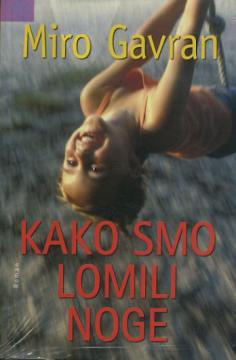
Kako smo lomili noge

Kako smo lomili noge

Miro Gavran

The novel How We Broke Our Legs (1997), a humorous and tender chronicle of family life through four decades of Croatian history, follows the fate of three generations of a Slavonian family from 1951 to 1992.

The main narrator, a young man from the family, grows up in a small Slavonian town, where his grandfather and father are bound by tradition and hard work in the fields, and his mother brings warmth and wisdom. The family moves to Zagreb in search of a better life, but a curse follows: broken legs become a metaphor for fateful blows – from socialist reforms, through student uprisings in 1968, to the collapse of Yugoslavia and the Homeland War. One of the first Croatian novels to address war, Gavran weaves it subtly, through personal stories of loss and resistance.

Through humor and irony, the author mocks everyday absurdities: boys in love who break bones for girls, family quarrels and dreams of freedom. Generational differences – from the war traumas of a grandfather to the young dreams of a grandson – celebrate solidarity and healing. Slavonia and Zagreb become the stage for a travelogue through love, loss and hope, reminding us that life, like a broken leg, heals with time and laughter.

Editor
Zoran Maljković
Titelseite
Fadil Vejzović
Maße
20 x 14 cm
Seitenzahl
184
Verlag
Mozaik knjiga, Zagreb, 2007.
 
Latein Schrift. Taschenbuch.
Sprache: Kroatisch.

Angeboten wird ein Exemplar

Zustand:Gebraucht, in ausgezeichnetem Zustand
Die Besonderheit dieses Exemplars:
Unterschrift des Autors
Widmung
Zum Warenkorb hinzugefügt!
 

Interessieren Sie sich für ein anderes Buch? Sie können das Angebot über unsere Suchmaschine suchen und finden oder Bücher nach Kategorien durchsuchen.

Diese Titel könnten Sie auch interessieren

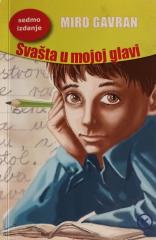
Svašta u mojoj glavi

Svašta u mojoj glavi

Miro Gavran
Mozaik knjiga, 2008.
Kroatisch. Latein Schrift. Taschenbuch.
4,99
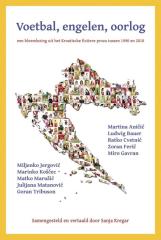
Voetbal, engelen, oorlog

Voetbal, engelen, oorlog

Miljenko Jergović, Julijana Matanović, Goran Tribuson, Ludwig Bauer, Ratko Cvetnić, Zoran Ferić, ...
KLIN, 2013.
Deutsch. Latein Schrift. Taschenbuch.
7,50
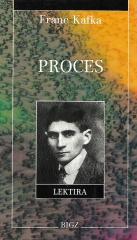
Proces

Proces

Franz Kafka

Kafka wrote The Process between 1914 and 1915, published posthumously in 1925. The novel is unfinished but with an added final chapter by Max Brod. Edition with a foreword by B. Živojinović and an afterword by Walter Killi.

BIGZ, 1990.
Serbisch. Latein Schrift. Taschenbuch.
4,26
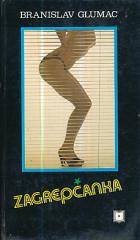
Zagrepčanka

Zagrepčanka

Branislav Glumac

Branislav Glumac published a novel without periods or commas in 1974, as the relentless stream of thought of a young rebel. Published in socialist Yugoslavia, the work caused a scandal with its openness and became a classic about generational rebellion.

IROS, 1986.
Kroatisch. Latein Schrift. Hardcover.
8,24
Andrićeva lestvica užasa

Andrićeva lestvica užasa

Svetislav Basara

A Serbian writer known for his satirical novels, Andrić's Ladder of Horrors dissects the Balkan mentality through a parable of Yugo-nostalgia and national myths. The title alludes to Ivo Andrić as a litmus test for criticism – Balkans claim him or reject

24 sata, 2021.
Serbisch. Latein Schrift. Taschenbuch.
11,56
Stotina godina (antikronika)

Stotina godina (antikronika)

Dario Harjaček

The novel One Hundred Years by Dario Harjaček provides a panoramic view of Trešnjevka and its inhabitants through a century of changes, ideologies, and human destinies – a mosaic of Zagreb in which life, art, and history intertwine.

Oceanmore, 2025.
Kroatisch. Latein Schrift. Taschenbuch.
13,42