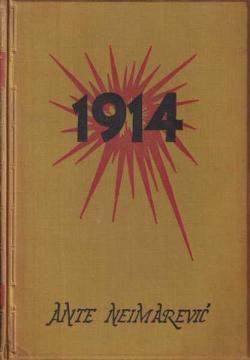
1914
Antiquität

1914

Ante Neimarević

The novel 1914 by Ante Neimarević is the first part of a satirical trilogy about World War I, published in 1937. The work is strongly autobiographical, as the author personally participated in the war as a member of the Bosnian-Herzegovinian infantry regi

The novel consists of three parts: "Mobilization", "Front" and "Background", which were published posthumously in 1976 under the title 1914–1918: a satirical novel about the First World War.

In the first part, "Mobilization", Neimarević depicts the atmosphere in a small Bosnian town after the assassination in Sarajevo and the beginning of the war. Through the characters of young recruits, the author depicts the absurdity and meaninglessness of war, using humor and satire to highlight the contrast between propaganda and reality.

The second part, "Front", follows young soldiers on the Galician battlefield, where they face the cruelties of war, death and the meaninglessness of combat. Despite the difficult conditions, the characters retain their spirit and humor, which helps them survive the horrors of war.

The third part, "Background", depicts the return of wounded soldiers to the rear, where they face the collapse of the Monarchy, hunger and the moral decline of society. Through grotesque situations and characters, the author criticizes the social and political structures that led to the war and its consequences.

Neimarević's work stands out for its original humor, rich language, and sharp criticism of wartime events, making it a significant contribution to Croatian literature.

Titelseite
Marijan Šimunić
Maße
20 x 14 cm
Seitenzahl
191
Verlag
Matica hrvatska, Zagreb, 1937.
 
Latein Schrift. Hardcover.
Sprache: Kroatisch.

Es werden zwei Exemplare angeboten

Kopiennummer 1

Zustand:Gebraucht, in sehr gutem Zustand
Die Besonderheit dieses Exemplars:
Unterschrift des Autors
Widmung
Nachteile/Unannehmlichkeiten:
  • Signature of previous owner
Zum Warenkorb hinzugefügt!

Kopiennummer 2

Zustand:Gebraucht, in nicht schlechtem Zustand
Nachteile/Unannehmlichkeiten:
  • Yellowed pages
  • Library stamp
  • Traces of patina
  • Cracked back
Zum Warenkorb hinzugefügt!
 

Interessieren Sie sich für ein anderes Buch? Sie können das Angebot über unsere Suchmaschine suchen und finden oder Bücher nach Kategorien durchsuchen.

Diese Titel könnten Sie auch interessieren

Feljtoni i novele

Feljtoni i novele

Ante Neimarević
Samizdat, 1977.
Kroatisch. Latein Schrift. Fester Einband mit Schutzumschlag.
9,99
Ranjeni pejzaž

Ranjeni pejzaž

Vladimir Mičetić

A book by Vladimir Mičetić, a doctor and volunteer of the Homeland War from Kutina. The work was awarded the literary prize "We Were the First When It Was Necessary" for 2010, awarded by the Association of Croatian Homeland War Veterans.

Spiritus Movens, 2010.
Kroatisch. Latein Schrift. Hardcover.
11,52
Most na reci Kvaj / Dželat

Most na reci Kvaj / Dželat

Pierre Boulle

The Bridge on the River Kwai (1952) is a famous story about British prisoners who, under pressure from the Japanese, build a bridge in the jungle. The Executioner (1954) is a philosophical novella about a Chinese executioner who becomes a victim of his ow

Minerva, 1960.
Serbisch. Latein Schrift. Hardcover.
4,26
Heinz Brandt, der Fremdenlegionär Nr. 101-110 (1915.)

Heinz Brandt, der Fremdenlegionär Nr. 101-110 (1915.)

A professionally bound set of 10 original newsstand novels from the legendary series. War issues in which Heinz Brandt, as a German soldier, takes part in the battles of World War I on various fronts. Extremely rare!

Mignon-Roman-Verlag, 1915.
Deutsch. Gotische Schrift. Hardcover.
Das Buch besteht aus 11 Bänden
115,00
Vrijeme nasilja

Vrijeme nasilja

Jean-Pierre Simon

A Time of Violence (1966) is an anti-war and activist novel by French writer Jean-Pierre Simon, a lesser-known author from the mid-20th century, whose work bears traces of leftist literature of the 1930s and 1940s.

Svjetlost, 1965.
Kroatisch. Latein Schrift. Taschenbuch.
2,46
Čočara

Čočara

Alberto Moravia

Widow Cesira and her daughter Rosetta flee bombed Rome to their native Ciociaria, where they experience hunger, fear and misery. Liberation brings tragedy: Rosetta is raped by Moroccan soldiers, destroying their faith in God and people.

Otokar Keršovani, 1966.
Kroatisch. Latein Schrift. Hardcover.
3,96