1914
Antique

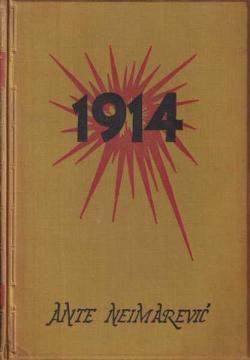
1914

Ante Neimarević

The novel 1914 by Ante Neimarević is the first part of a satirical trilogy about World War I, published in 1937. The work is strongly autobiographical, as the author personally participated in the war as a member of the Bosnian-Herzegovinian infantry regi

The novel consists of three parts: "Mobilization", "Front" and "Background", which were published posthumously in 1976 under the title 1914–1918: a satirical novel about the First World War.

In the first part, "Mobilization", Neimarević depicts the atmosphere in a small Bosnian town after the assassination in Sarajevo and the beginning of the war. Through the characters of young recruits, the author depicts the absurdity and meaninglessness of war, using humor and satire to highlight the contrast between propaganda and reality.

The second part, "Front", follows young soldiers on the Galician battlefield, where they face the cruelties of war, death and the meaninglessness of combat. Despite the difficult conditions, the characters retain their spirit and humor, which helps them survive the horrors of war.

The third part, "Background", depicts the return of wounded soldiers to the rear, where they face the collapse of the Monarchy, hunger and the moral decline of society. Through grotesque situations and characters, the author criticizes the social and political structures that led to the war and its consequences.

Neimarević's work stands out for its original humor, rich language, and sharp criticism of wartime events, making it a significant contribution to Croatian literature.

Graphics design
Marijan Šimunić
Dimensions
20 x 14 cm
Pages
191
Publisher
Matica hrvatska, Zagreb, 1937.
 
Latin alphabet. Hardcover.
Language: Croatian.

Two copies are available

Copy number 1

Condition:Used, very good condition
Specificity of this instance:
Author signature
Dedication
Damages or inconvenience notice:
  • Signature of previous owner

Copy number 2

Condition:Used, condition good enough
Damages or inconvenience notice:
  • Yellowed pages
  • Library stamp
  • Traces of patina
  • Cracked back
 

Are you interested in another book? You can search the offer using our search engine or browse books by category.

You may also be interested in these titles

Feljtoni i novele

Feljtoni i novele

Ante Neimarević
Samizdat, 1977.
Croatian. Latin alphabet. Hardcover with dust jacket.
9.99
Osječani, gdje ste, da ste: Društvena kronika umirovljenika Lojzeka

Osječani, gdje ste, da ste: Društvena kronika umirovljenika Lojzeka

Alojzije Šmit

In his book Osijekians, where are you, if you were... (1994), Alojzije Šmit presents a humorous and nostalgic social chronicle through the character of the pensioner Lojzek.

Otvoreno sveučilište Osijek, 1994.
Croatian. Latin alphabet. Paperback.
2.46 - 3.98
Figarova ženidba ili Ludi dan: Komedija u pet ćinova

Figarova ženidba ili Ludi dan: Komedija u pet ćinova

Pierre-Augustin Caron de Beaumarchais

The comedy "The Marriage of Figaro, or The Mad Day" (1784) is a sequel to The Barber of Seville. The Marriage of Figaro criticizes social injustices through love affairs and intrigue, celebrating Figaro and Susanna's ingenuity in the fight against aristoc

Srpska književna zadruga (SKZ), 1925.
Serbian. Cyrillic alphabet. Hardcover.
7.58
Priče Branislava Nušića

Priče Branislava Nušića

Branislav Nušić

A selection from Nušić's shorter humorous stories, which he wrote and published mainly in newspapers and magazines. With a foreword by A. G. Matoš.

Matica hrvatska, 1912.
Croatian. Latin alphabet. Paperback.
7.42
Pustolovine baruna Münchhausena

Pustolovine baruna Münchhausena

Gottfried August Bürger

The Adventures of Baron Münchhausen by Gottfried August Bürger, published in 1786, is a humorous work based on a real person, Baron Hieronymus Karl Friedrich von Münchhausen, known for his exaggerated stories.

Grafički zavod Hrvatske (GZH), 1988.
Croatian. Latin alphabet. Hardcover.
11.56
Gradić gdje je vrijeme stalo

Gradić gdje je vrijeme stalo

Bohumil Hrabal

Bohumil Hrabal, a Czech writer known for his lyrical grotesque and humor, in his novel The Town Where Time Stood Still evokes childhood in the small town of Libeň (part of Prague), where time seems to stand still in a magical but melancholic world.

Hena Com, 2006.
Croatian. Latin alphabet. Paperback.
7.62