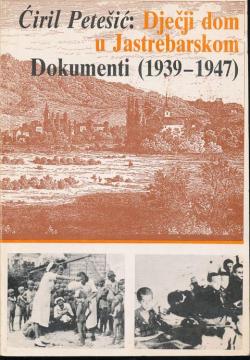
Dječji dom u Jastrebarskom: Dokumenti (1939-1947.)

Dječji dom u Jastrebarskom: Dokumenti (1939-1947.)

Ćiril Petešić

The book focuses on the period when a children's camp existed in Jastrebarsko for children brought from the Stara Gradiška camp and other Jasenovac camps, from July 12th to the beginning of November 1942.

The reason for this is that a large number of articles, feuilletons, and several books were devoted to this period in our post-war press, but no critical account of the events was given. Another reason is that the most important documents were not published in their entirety. Some of them, if they were quoted, were used for the purpose of a particular discussion or book, but not those parts of the documents that give things a noticeably different light. The third reason is that numerous "memories" were published, created 30-40 years after the events in Jastrebarski during the Second World War. "Memories" were published mostly in fragments, and they are nevertheless second-rate (secondary) documents. For these reasons, I tried to pay as much attention as possible to the publication of the primary documents in their entirety, and in this respect, in my opinion, the value of this book lies. Until now, readers have not had the opportunity to notice that the short history of the children's home in Jastrebarski had several phases: pre-war, when Banovina Hrvatska founded its home for orphans, initial wartime, until the camp for children from the Jasenovac camps was added to the children's home, which existed for almost 4 months, a further phase until the end of the war and a post-war phase. The establishment of a children's infectious disease hospital was particularly significant, which continued to operate as an epidemic hospital after the end of the children's camp. In addition, there were actually three children's homes in Jastrebarski, and they were state children's homes, under the care and supervision of the Banovina Hrvatska, the Ministry of the NDH and after the war the Republic of Croatia.

Graphics design
Martina Petek Stupar
Dimensions
24 x 17 cm
Pages
212
Publisher
Kršćanska sadašnjost, Zagreb, 1990.
 
Distribution: 1,200 copies
 
Latin alphabet. Paperback.
Language: Croatian.
ISBN
8-63-970084-2

One copy is available

Condition:Used, excellent condition
Discounted price: 19.9814.99
25% discount is valid until 9/16/25 11:59 pm
 

Are you interested in another book? You can search the offer using our search engine or browse books by category.

You may also be interested in these titles

Srednjovjekovni statut grada Budve

Srednjovjekovni statut grada Budve

With a foreword by the translator Nikola Vučković.

Turistički savez - Budva, 1970.
Croatian. Latin alphabet. Hardcover.
14.56
Sječa Hrvatske u Karađorđevu 1971.: autorizirani zapisnik

Sječa Hrvatske u Karađorđevu 1971.: autorizirani zapisnik

Meditor, 1994.
Croatian. Latin alphabet. Hardcover.
20.36
Hrvatska u arhivima izbjegličke vlade 1941-1943.: Izvještaji informatora o prilikama u Hrvatskoj

Hrvatska u arhivima izbjegličke vlade 1941-1943.: Izvještaji informatora o prilikama u Hrvatskoj

Ljubo Boban

Akademiker Ljubo Boban in seinem Werk „Kroatien im Archiv der Exilregierung 1941–1943“. bringt eine Sammlung diplomatischer Berichte aus verschiedenen europäischen und internationalen Vertretungen der jugoslawischen Exilregierung während des Zweiten Weltk

Globus, 1985.
Croatian. Latin alphabet. Hardcover with dust jacket.
9.527.14
Bijela knjiga Stipe Šuvara: Originalni dokument Centra CK SKH za informiranje i propagandu od 21. ožujka 1984.

Bijela knjiga Stipe Šuvara: Originalni dokument Centra CK SKH za informiranje i propagandu od 21. ožujka 1984.

Die „Bijela knjiga“ wurde erstmals in einer Buchausgabe veröffentlicht. Es handelt sich um ein historisches Dokument, das 1984 vom CK SKH Informations- und Propagandazentrum erstellt wurde.

Večernji posebni proizvodi d.o.o, 2010.
Croatian. Latin alphabet. Hardcover.
11.32
Tumač obćemu austrijskomu gradjanskomu zakoniku I - II

Tumač obćemu austrijskomu gradjanskomu zakoniku I - II

Adolf Rušnov

Das 1811 veröffentlichte Allgemeine österreichische Zivilgesetzbuch stellt nach dem berühmten französischen Code Civil von 1804 die zweite bedeutende Kodifizierung des Zivilrechts in Europa dar. OGZ in Kroatien und Slawonien wurde 1852 eingeführt, als das

Knjižarnica Lavoslava Hartmana, 1891.
Croatian. Latin alphabet. Hardcover.
The book consists of two volumes
130.00
Tito: 120 godina u 120 fotografija - najbolje zaboravljene snimke iz privatnih albuma i javnih arhiva

Tito: 120 godina u 120 fotografija - najbolje zaboravljene snimke iz privatnih albuma i javnih arhiva

Tvrtko Jakovina

Die Monografie enthält 120 sorgfältig ausgewählte Fotografien aus privaten Alben und öffentlichen Archiven, die Schlüsselmomente aus Titos Leben und politischer Karriere veranschaulichen. Mit historischem Kommentar Tvrtko Jakovine.

Globus, 2012.
Croatian. Latin alphabet. Paperback.
5.26