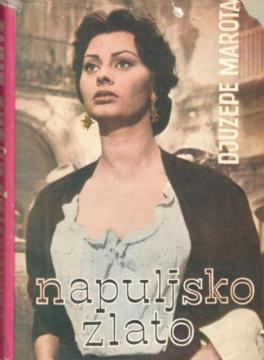
Napuljsko zlato

Napuljsko zlato

Giuseppe Marotta

A collection of stories about Naples that celebrates the indestructible spirit and resourcefulness of its inhabitants. Through melancholy, humor, and everyday drama, Marotta reveals the city's true "gold"—the wisdom and dignity of the little man.

The Gold of Naples (1947) is the celebrated masterpiece of the Italian writer and journalist Giuseppe Marotta. This collection of closely related sketches, stories and memoirs is a moving and vivid tribute to the author's hometown. Marotta leads us through the steep streets, bustling squares and stuffy courtyards of Naples, painting a gallery of distinctive characters - from street vendors, petty swindlers and impoverished nobles to touchingly dignified families struggling with the hardships of everyday life.

The "gold" of the title does not denote material wealth, but the indestructible spirit, humor, ingenuity and philosophical resignation to fate with which the Neapolitans survive all historical hardships, poverty and injustices. Marotta's style combines a subtle journalistic gift of observation with lyrical melancholy, warm irony and bittersweet humor.

The book became an extremely influential classic of Italian post-war realism and enjoyed great popularity throughout Europe. Its timeless value was further confirmed in 1954, when the famous director Vittorio De Sica made an anthology neorealist film of the same name based on it, starring Sophia Loren, Totò and Silvana Mangano.

Titel des Originals
L'oro di Napoli
Übersetzung
Milan Radmanović, Leposava Nikolić
Editor
Milivoje Jovanović
Maße
19,5 x 14 cm
Seitenzahl
197
Verlag
Mlado pokolenje, Beograd, 1959.
 
Latein Schrift. Fester Einband mit Schutzumschlag.
Sprache: Serbisch.

Es werden zwei Exemplare angeboten

Kopiennummer 1

Zustand:Gebraucht, in ausgezeichnetem Zustand
Nachteile/Unannehmlichkeiten:
  • Slight damage to the dust jacket
Zum Warenkorb hinzugefügt!

Kopiennummer 2

Zustand:Gebraucht, in sehr gutem Zustand
Nachteile/Unannehmlichkeiten:
  • Traces of patina
  • The cover is missing
Reduzierter Preis: 4,823,86
Der Rabatt von 20 % gilt bis zum 31.12.2026 23:59 Uhr
Zum Warenkorb hinzugefügt!
 

Interessieren Sie sich für ein anderes Buch? Sie können das Angebot über unsere Suchmaschine suchen und finden oder Bücher nach Kategorien durchsuchen.

Diese Titel könnten Sie auch interessieren

Maskarada / Bračna ljubav

Maskarada / Bračna ljubav

Alberto Moravia

In „Maskerade“ zeichnet Moravia ein satirisches Bild des faschistischen Italiens durch absurde politische Intrigen und Verkleidungen. „Eheliche Liebe“ erkundet auf intime Weise erotische Spannungen, Besitzgier und emotionale Entfremdung im Alltag.

Otokar Keršovani, 1966.
Serbisch. Latein Schrift. Hardcover.
3,22 - 3,86
Hronika o siromašnim ljubavnicima

Hronika o siromašnim ljubavnicima

Vasco Pratolini

Florenz 1925–1926: In der armen Via del Corno leben die Bewohner in Liebe, Armut und Angst. Die Ankunft des Faschismus zerstört die Gemeinschaft: Liebende streiten, manche sterben durch Gewalt, doch der Zusammenhalt der Bevölkerung bleibt bestehen.

Svjetlost, 1966.
Serbisch. Latein Schrift. Taschenbuch.
Das Buch besteht aus zwei Bänden
4,56
Djevica i mondena: Roman iz rimskog života

Djevica i mondena: Roman iz rimskog života

Mario Puccini

"The Virgin and the Modest" by Italian writer Mario Puccini is a novel set in Roman life that explores love, morality, social differences, and the position of women in modern society through the contrast of two female characters.

Naklada zaklade tiskare Narodnih novina, 1924.
Kroatisch. Latein Schrift. Hardcover.
4,62
Povijest talijanske književnosti – Prvi dio: Starije doba (500–1600)

Povijest talijanske književnosti – Prvi dio: Starije doba (500–1600)

Vinko Lozovina

The first systematic Croatian history of Italian literature from the Middle Ages to the Renaissance. Vinko Lozovina, a distinguished professor and Italian scholar, systematically covers the period from the early Middle Ages to the end of the 16th century.

Matica hrvatska, 1909.
Kroatisch. Latein Schrift. Taschenbuch.
8,56
Das Foucaultsche Pendel

Das Foucaultsche Pendel

Umberto Eco

Three bored Milanese editors invent a gigantic conspiracy "Plan" linked to the Templars and occult societies. The game becomes a deadly reality.

Deutscher Bücherbund, 1989.
Deutsch. Latein Schrift. Fester Einband mit Schutzumschlag.
11,36
Nikome nema povratka

Nikome nema povratka

Alba de Céspedes

Nikome nema povratka (1938.) prati živote osam mladih žena u rimskom studentskom domu, njihove ljubavi, ambicije i sudbine u talijanskom društvu pred Drugi svjetski rat, pokazujući da se prošlost ne može vratiti ni pobjeći od sebe.

Nakladni zavod Ante Velzek, 1941.
Kroatisch. Latein Schrift. Hardcover.
Das Buch besteht aus zwei Bänden
12,42