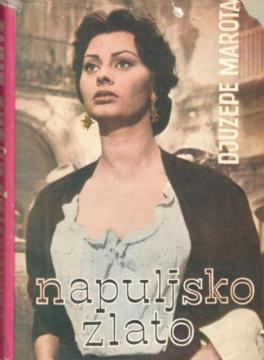
Napuljsko zlato

Napuljsko zlato

Giuseppe Marotta

A collection of stories about Naples that celebrates the indestructible spirit and resourcefulness of its inhabitants. Through melancholy, humor, and everyday drama, Marotta reveals the city's true "gold"—the wisdom and dignity of the little man.

The Gold of Naples (1947) is the celebrated masterpiece of the Italian writer and journalist Giuseppe Marotta. This collection of closely related sketches, stories and memoirs is a moving and vivid tribute to the author's hometown. Marotta leads us through the steep streets, bustling squares and stuffy courtyards of Naples, painting a gallery of distinctive characters - from street vendors, petty swindlers and impoverished nobles to touchingly dignified families struggling with the hardships of everyday life.

The "gold" of the title does not denote material wealth, but the indestructible spirit, humor, ingenuity and philosophical resignation to fate with which the Neapolitans survive all historical hardships, poverty and injustices. Marotta's style combines a subtle journalistic gift of observation with lyrical melancholy, warm irony and bittersweet humor.

The book became an extremely influential classic of Italian post-war realism and enjoyed great popularity throughout Europe. Its timeless value was further confirmed in 1954, when the famous director Vittorio De Sica made an anthology neorealist film of the same name based on it, starring Sophia Loren, Totò and Silvana Mangano.

Original title
L'oro di Napoli
Translation
Milan Radmanović, Leposava Nikolić
Editor
Milivoje Jovanović
Dimensions
19.5 x 14 cm
Pages
197
Publisher
Mlado pokolenje, Beograd, 1959.
 
Latin alphabet. Hardcover with dust jacket.
Language: Serbian.

Two copies are available

Copy number 1

Condition:Used, excellent condition
Damages or inconvenience notice:
  • Slight damage to the dust jacket

Copy number 2

Condition:Used, very good condition
Damages or inconvenience notice:
  • Traces of patina
  • The cover is missing
Discounted price: 4.823.86
20% discount is valid until 12/31/26 11:59 pm
 

Are you interested in another book? You can search the offer using our search engine or browse books by category.

You may also be interested in these titles

Zmijsko leglo

Zmijsko leglo

Andrea Camilleri

Snake's Nest (2008) is part of the series about Inspector Salvo Montalban. Set in the fictional Sicilian town of Vigàtu, the novel combines criminal suspense, psychological depth, and Camilleri's signature humor with a critique of Sicily's social problems

Profil Knjiga, 2014.
Croatian. Latin alphabet. Paperback.
8.36
Pažnja

Pažnja

Alberto Moravia

Francesco Merighi returns to Rome after 9 years abroad. In order to write an "authentic" novel, he keeps a diary of his life with his wife and their daughter Babe. He obsessively analyzes lies in relationships, the temptation of

Otokar Keršovani, 1966.
Croatian. Latin alphabet. Hardcover.
3.96
Božanstvena komedija: Pakao

Božanstvena komedija: Pakao

Dante Alighieri

Inferno is the first part of Dante's Divine Comedy. In Inferno, he begins his journey with Virgil, who will guide him through all three states of the soul all the way to God himself. This is the second edition of Isa Kršnjavi's translation into Croatian.

Grafički, umjetnički i nakladni zavod Jugoslavija, 1919.
Croatian. Latin alphabet. Hardcover.
48.56
Sestre Materassi

Sestre Materassi

Aldo Palazzeschi

The novel The Materassi Sisters, published in 1934, is the most famous work of the Italian writer Aldo Palazzeschi. The story is set in the suburb of Florence, Santa Maria a Coverciano, between 1918 and 1928.

Nakladni zavod Ante Velzek, 1944.
Croatian. Latin alphabet. Hardcover.
The book consists of two volumes
9.56 - 13.26
Život je igra

Život je igra

Alberto Moravia

The book consists of several stories that explore the complexity of human behavior, often through an ironic and satirical depiction of everyday life.

Svjetlost, 1965.
Serbian. Latin alphabet. Paperback.
3.46 - 3.72
U sjeni bregova

U sjeni bregova

Paola Drigo

The novel depicts the tragic fate of Mariuta (Marije Zef) and her younger sister Rosuta. The work shocked contemporaries with its boldness in depicting taboo subjects, and is today considered a classic portrait of female suffering in rural Italy.

Matica hrvatska, 1961.
Croatian. Latin alphabet. Hardcover with dust jacket.
5.32