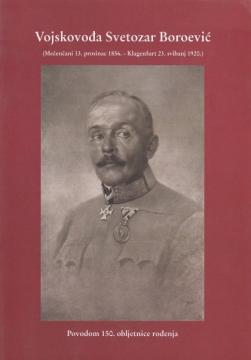
Vojskovođa Svetozar Boroević 1856-1920.

Vojskovođa Svetozar Boroević 1856-1920.

Milan Pojić

Svetozar Boroević, the most capable Austro-Hungarian military leader of the First World War, the only Croat who received the title of field marshal and was awarded the highest Austrian decorations, has been systematically hushed up in Croatian history.

"Ignorance of the basic facts about Svetozar Boroević, and even more the assessment of his person and works by the politicians of the subsequent state formations in which Croatia found itself, from monarchist to socialist Yugoslavia, turned the great military leader and Croatian patriot into a victim of stereotypes. The first, and a similar fate followed ban Josip Jelačić for a long time, is that Boroević is more of an imperial/Austro-Hungarian general and military leader, and less of a "Croatian/Yugoslav patriot". He cares more about the salvation of the Monarchy than about the interests of the Croatian homeland and the Croatian people. Another stereotype is that he was born into an Orthodox border family, so he is therefore a Serb. This stereotype, which was very successfully promoted by the Serbian Orthodox Church and accepted by the wider Croatian public, led to the fact that in the last biography of Boroević published in 1989 in the Croatian Biographical Lexicon, the Miroslav Krleža Lexicographic Institute in Zagreb considered it necessary to mention that Boroević was "of origin is from a Serbian border family". None of the above stereotypes is correct."

Übersetzung
Danijela Marjanić
Maße
24 x 17 cm
Seitenzahl
31
Verlag
Hrvatski državni arhiv, Zagreb, 2006.
 
Latein Schrift. Taschenbuch.
Sprache: Kroatisch.

Angeboten wird ein Exemplar

Zustand:Gebraucht, in ausgezeichnetem Zustand
Zum Warenkorb hinzugefügt!
 

Interessieren Sie sich für ein anderes Buch? Sie können das Angebot über unsere Suchmaschine suchen und finden oder Bücher nach Kategorien durchsuchen.

Diese Titel könnten Sie auch interessieren

Komunizam i čovjek: Odnos vlasti i pojedinca u Hrvatskoj (1958.–1972.)

Komunizam i čovjek: Odnos vlasti i pojedinca u Hrvatskoj (1958.–1972.)

Josip Mihaljević

Josip Mihaljević's book analyzes the relationship between the government and the individual in communist Croatia (1958–1972), through repressive mechanisms, ideological pressures, and restrictions on personal freedom in the socialist system.

Hrvatski institut za povijest, 2016.
Kroatisch. Latein Schrift. Hardcover.
17,26
Putovanje po Bosni

Putovanje po Bosni

Ivan Kukuljević Sakcinski

Ivan Kukuljević Sakcinski's travelogue provides a vivid account of Bosnia in the mid-19th century, recording the landscape, customs, political circumstances, and everyday life under Ottoman rule.

Fortuna d.o.o., 2007.
Kroatisch. Latein Schrift. Hardcover.
14,60
Knezovi, kraljevi, biskupi

Knezovi, kraljevi, biskupi

Neven Budak

Vjerojatno svaki povjesničar katkad osjeti potrebu da i sam mašta o osobama o kojima piše, da se pokuša uživjeti u vremena koja su predmet njegova znanstvenog istraživanja.

Slobodna Dalmacija, 2005.
Kroatisch. Latein Schrift. Taschenbuch.
6,00
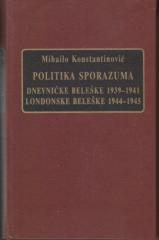
Politika sporazuma: dnevničke beleške 1939-1941, londonske beleške 1944-1945

Politika sporazuma: dnevničke beleške 1939-1941, londonske beleške 1944-1945

Mihailo Konstantinović

Generacija kojoj je pripadao Konstantinović uspjela je doći do sporazuma i, da nije bilo Drugog svjetskog rata, nalazila se na pragu da u Jugoslaviji ukorijeni liberalnu demokraciju čiji je pristalica bio Konstantinović.

Agencija Mir, 1998.
Serbisch. Latein Schrift. Hardcover.
39,99
U modi: Kultura odijevanja porečkih plemenitih građana (1650.-1720.)

U modi: Kultura odijevanja porečkih plemenitih građana (1650.-1720.)

Elena Uljančić

Knjiga predstavlja novinu ne samo u istarskoj, već i u hrvatskoj historiografiji. Naime, kultura odijevanja na području Istre u ranom novom vijeku još uopće nije analizirana, a za područje Dalmacije tek sporadično.

Srednja Europa, 2019.
Kroatisch. Latein Schrift. Hardcover.
16,9911,89
Izvori za hrvatsku povijest do 1526. godine

Izvori za hrvatsku povijest do 1526. godine

Nada Klaić

The work presents key narrative and diplomatic sources for Croatian history up to 1526, with a critical analysis of their reliability, context, and interconnections, and emphasizes the development of Croatian political structures throughout the Middle Age

Fortuna d.o.o., 2019.
Kroatisch. Latein Schrift. Hardcover.
22,56