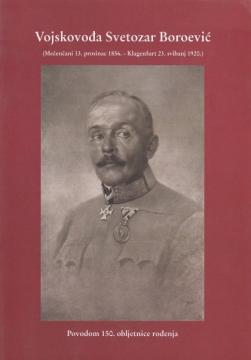
Vojskovođa Svetozar Boroević 1856-1920.

Vojskovođa Svetozar Boroević 1856-1920.

Milan Pojić

Svetozar Boroević, the most capable Austro-Hungarian military leader of the First World War, the only Croat who received the title of field marshal and was awarded the highest Austrian decorations, has been systematically hushed up in Croatian history.

"Ignorance of the basic facts about Svetozar Boroević, and even more the assessment of his person and works by the politicians of the subsequent state formations in which Croatia found itself, from monarchist to socialist Yugoslavia, turned the great military leader and Croatian patriot into a victim of stereotypes. The first, and a similar fate followed ban Josip Jelačić for a long time, is that Boroević is more of an imperial/Austro-Hungarian general and military leader, and less of a "Croatian/Yugoslav patriot". He cares more about the salvation of the Monarchy than about the interests of the Croatian homeland and the Croatian people. Another stereotype is that he was born into an Orthodox border family, so he is therefore a Serb. This stereotype, which was very successfully promoted by the Serbian Orthodox Church and accepted by the wider Croatian public, led to the fact that in the last biography of Boroević published in 1989 in the Croatian Biographical Lexicon, the Miroslav Krleža Lexicographic Institute in Zagreb considered it necessary to mention that Boroević was "of origin is from a Serbian border family". None of the above stereotypes is correct."

Translation
Danijela Marjanić
Dimensions
24 x 17 cm
Pages
31
Publisher
Hrvatski državni arhiv, Zagreb, 2006.
 
Latin alphabet. Paperback.
Language: Croatian.

One copy is available

Condition:Used, excellent condition
 

Are you interested in another book? You can search the offer using our search engine or browse books by category.

You may also be interested in these titles

Zagreb tisuću devetsto četrdeset prve

Zagreb tisuću devetsto četrdeset prve

Ivan Šibl

"Zagreb one thousand nine hundred and forty-first" is not only a historical overview of events, but at the same time it is also a book in which the author vividly and directly outlined dozens of portraits. A book that is at the same time a historiographic

Naprijed, 1967.
Croatian. Latin alphabet. Hardcover with dust jacket.
7.985.99
U logorima Manjače i Gline

U logorima Manjače i Gline

Vladimir Štefanac

In the camps of Manjača and Glina: Testimonies of Croatian veterans This is the second book by Vladimir Štefanac, and it tells about the fighting in Kostajnica and the imprisonment at Manjača.

Consilium, 1996.
Croatian. Latin alphabet. Paperback.
9.98
Kroz oluju vremena

Kroz oluju vremena

Jakov Jurić-Klišanin
Hrvatsko kulturno društvo "Napredak", 1995.
Croatian. Latin alphabet. Hardcover with dust jacket.
10.36 - 11.99
60 godina djelovanja OŠ Dobriša Cesarić

60 godina djelovanja OŠ Dobriša Cesarić

OŠ Dobriša Cesarić, 1999.
Croatian. Latin alphabet. Paperback.
2.00
Hrvatska

Hrvatska

Grga Novak, Zvane Črnja
Jugoslovenska revija, 1976.
Croatian. Latin alphabet. Hardcover with dust jacket.
13.98
Tumač obćemu austrijskomu gradjanskomu zakoniku I - II

Tumač obćemu austrijskomu gradjanskomu zakoniku I - II

Adolf Rušnov

The General Austrian Civil Code, published in 1811, represents the second significant codification of civil law in Europe after the famous French Code Civil from 1804. OGZ in Croatia and Slavonia was introduced in 1852, when imperial patent no. 246.

Knjižarnica Lavoslava Hartmana, 1891.
Croatian. Latin alphabet. Hardcover.
The book consists of two volumes
130.00