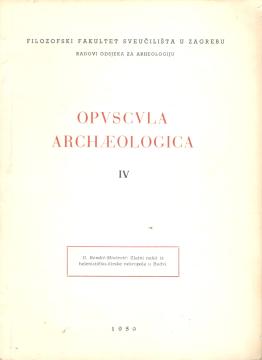
Opuscula archaeologica IV: Zlatni nakit iz helenističko-ilirske nekropole u Budvi

Opuscula archaeologica IV: Zlatni nakit iz helenističko-ilirske nekropole u Budvi

Duje Rendić-Miočević

The article presents a classic analysis of archaeological findings from the Hellenistic period (3rd-2nd century BC) in the necropolis north of ancient Budva (today's Montenegro), discovered in the 1950s.

The author catalogues and describes in detail the gold jewellery from 12 graves: spiral bracelets in the shape of snakes made of thin gold sheet (wt. 10-20 g), earrings with pyramidal designs (upturned pyramids with granulated decorations), circular zoomorphic earrings with lion and bull motifs, fibulae, rings with intaglio and chains with pendants. He analyses the processing techniques (forging, filigree work, granulation), styles (Hellenistic influences with Illyrian variants) and context: the jewellery was found in female and male graves with ceramics, bronze and iron, indicating elite burial rituals. Rendić-Miočević compares it with parallel finds from Glasinac, Trebenište and Greek centres, dating them to the Macedonian phase of Hellenism.

These objects, weighing a total of over 200 g, are rare examples of high-value gold in the Illyrian region, testifying to the wealth of local tribes (probably the Doclea or Labeati). The motifs (snakes as a symbol of protection, zoomorphic elements) reveal a synthesis of Greek influences and autochthonous symbolism, and the quality of the workmanship points to masters from Macedonia or Epirus. The findings confirm Budva as an important commercial and cultural center on the Adriatic.

The work enriches the picture of Illyrian civilization, illustrating Hellenistic acculturation in the Balkans: the spread of Greek art through trade and migration, social hierarchy (jewelry as a status symbol), and ethnic interactions. As one of the first detailed studies of Illyrian gold, it influenced later research (e.g. in Trebenište, Apollonia), helping to reconstruct Balkan routes and the transition from the Iron Age to the Hellenistic Age. It remains a reference for understanding the pre-Roman Adriatic and Illyrian-Greek connections.

Dimensions
23 x 17 cm
Pages
60
Publisher
Filozofski fakultet Sveučilišta u Zagrebu, Zagreb, 1959.
 
Latin alphabet. Paperback.
Language: Croatian.

One copy is available

Condition:Used, excellent condition
Discounted price: 9.367.02
25% discount is valid until 12/23/25 11:59 pm
 

Are you interested in another book? You can search the offer using our search engine or browse books by category.

You may also be interested in these titles

Najveće kulture svijeta 1: Egipat

Najveće kulture svijeta 1: Egipat

Ania Skliar

„The Greatest Cultures of the World“ ist eine Sammlung von acht Büchern, die über die großen Zivilisationen der Welt sprechen. Die Bücher wurden erstmals 2005 in Rijeka vom Verlag Extrada d.o.o. in Kroatien veröffentlicht, alle acht Bücher wurden jedoch a

Extrade, 2005.
Croatian. Latin alphabet. Hardcover.
6.324.42
Tutankhamon: Kralj u zlatnim kovčezima

Tutankhamon: Kralj u zlatnim kovčezima

Otto Neubert

Der Autor, einer der lebenden Augenzeugen der Ausgrabungen im Tal der Könige, vermittelt dem Leser ein populärwissenschaftliches Bild nicht nur eines der berühmtesten altägyptischen Herrscher, sondern auch der interessantesten Fakten zum ethnologischen, p

Stvarnost, 1977.
Croatian. Latin alphabet. Hardcover.
8.56
Povijest #15: Kolonijalna carstva i imperijalizam (1871.-1914.)

Povijest #15: Kolonijalna carstva i imperijalizam (1871.-1914.)

Der fünfzehnte Band der Weltgeschichte-Reihe behandelt die Zeit von 1871 bis 1914, die vom Höhepunkt des Kolonialismus und Imperialismus geprägt war. Das reich bebilderte Buch bietet einen umfassenden Überblick über diese Zeit globaler Veränderungen und S

Europapress holding, 2008.
Croatian. Latin alphabet. Hardcover.
9.32 - 9.46
Povijest svijeta od početka do danas

Povijest svijeta od početka do danas

Jochen Bleicken, Vladimir Brodnjak
Naprijed, 1976.
Croatian. Latin alphabet. Hardcover with dust jacket.
26.36 - 29.75
Ilustrirana povijest svijeta: Rani srednji vijek (907.-1154.)

Ilustrirana povijest svijeta: Rani srednji vijek (907.-1154.)

Karin Feuerstein-Praßer, Andrea Groß-Schulte, Marion Jung, Cornelia Lawrenz, Karin Prager, Otto S...

Der vierte Band der „Illustrated History of the World“-Reihe von Reader's Digest ist in Farbe illustriert und richtet sich an Geschichtsinteressierte. Er bietet einen Überblick über wichtige Ereignisse und zivilisatorische Errungenschaften auf der ganzen

Mozaik knjiga, 2010.
Croatian. Latin alphabet. Hardcover.
11.56
Rodoslov poglavara Totonikapana

Rodoslov poglavara Totonikapana

Bagdala, 1983.
Serbian. Latin alphabet. Paperback.
4.99