Gerhart Hauptmann
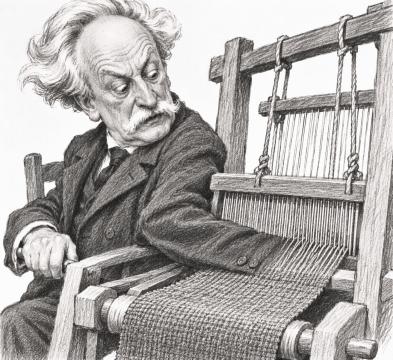
There is no single hero in The Weavers (Die Weber, 1892) to speak for everyone. From house to house, we hear people who weave for a living and can scarcely feed their families on what they earn. Gerhart Hauptmann (1862–1946) drew on the Silesian weavers’ uprising of 1844 for a play that builds tension out of ordinary conversations about the price of cloth, hunger and how long anyone can endure humiliation. By the time the revolt breaks out, the audience already knows what brought the weavers to it.
Hauptmann was born in Ober-Salzbrunn, Silesia, now Szczawno-Zdrój in Poland, the son of an innkeeper. He studied sculpture at the art academy in Breslau, now Wrocław, and natural sciences and philosophy in Jena. His breakthrough in the theatre came with Before Sunrise (Vor Sonnenaufgang, 1889). In 1912 he received the Nobel Prize in Literature. He died in Agnetendorf, now Jagniątków.
In naturalist plays such as Drayman Henschel (Fuhrmann Henschel, 1898) and Rose Bernd (1903), Hauptmann examines how a person’s surroundings narrow the choices open to them. In the comedy The Beaver Coat (Der Biberpelz, 1893), the theft of a fur coat exposes the authorities’ weaknesses. While officials focus their suspicions on people who interest them politically, a resourceful washerwoman outwits them in plain sight.
Hauptmann also wrote plays that draw on fairy tales and symbolism. In The Sunken Bell (Die versunkene Glocke, 1896), a bell-founder is torn between family life and the art to which he wants to give himself entirely. The tragicomedy The Rats (Die Ratten, 1911) returns to the city. Under the same Berlin roof, theatrical ambitions collide with the desperation of a woman who wants a child. From Silesian weavers to the inhabitants of a Berlin tenement, Hauptmann shows how much we can learn about a society by listening to the people it rarely gives a chance to speak.
Titles in our offer

Otok velike matere
After a shipwreck, a group of women establishes an isolated island society governed by matriarchal principles. Their utopian experiment faces conflicts involving motherhood, gender, power and social restrictions.