Isak E. Babelj
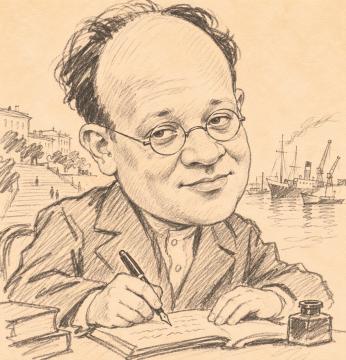
Isaac Emmanuilovich Babel (Odessa, 1894 – Moscow, 27 January 1940) was a Russian-language short-story writer, playwright and screenwriter of Jewish origin, and a major master of twentieth-century short fiction. He grew up in multilingual Odessa, whose streets, courtyards, merchants and gangsters became enduring sources for his writing. His first story appeared in 1913, and Maxim Gorky provided important encouragement early in his literary career.
In 1920 Babel accompanied Semyon Budyonny’s First Cavalry Army during the Polish-Soviet War. His diary and experiences became the foundation of Red Cavalry (Конармия, 1926), a cycle confronting revolutionary ideals with the cruelty of warfare. Its narrator, Kirill Lyutov, embodies the conflict between intellectual sensitivity and the desire to belong among fighting men.
His other major fictional world appears in Odessa Stories (Одесские рассказы, collected in 1931), particularly the tales of gangster Benya Krik. Humour, exaggeration and distinctive speech create a portrait of Jewish urban life that is exuberant, violent and vulnerable to historical upheaval. Autobiographical stories, notably The Story of My Dovecote, explore childhood, antisemitism and exposure to violence. His dramatic works include Sunset (Закат, 1928) / Maria (Мария, 1935), alongside work for cinema.
Compression, precise imagery and the collision of lyricism with brutality distinguish his prose. Abrupt endings frequently transform the meaning of a scene, confronting readers with moral questions that resist easy answers.
Arrested in 1939 during Stalinist repression, Babel was executed in 1940 on fabricated charges and posthumously rehabilitated in 1954. His surviving work remains an important literary exploration of revolution, Jewish identity and the violence inflicted on individuals by history.
Titles in our offer
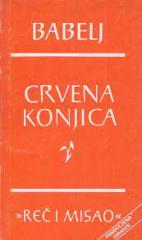
Crvena konjica
Babel’s linked stories follow the Red Cavalry during the Polish-Soviet War of 1920, confronting revolutionary ideals with violence, civilian suffering and an intellectual’s uneasy place among warriors.
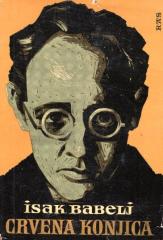
Crvena konjica
Babel’s linked stories follow the Red Cavalry during the Polish-Soviet War of 1920, confronting revolutionary ideals with violence, civilian suffering and an intellectual’s uneasy place among warriors.

Crvena konjica
Babel’s linked stories follow the Red Cavalry during the Polish-Soviet War of 1920, confronting revolutionary ideals with violence, civilian suffering and an intellectual’s uneasy place among warriors.
