Adam Smith
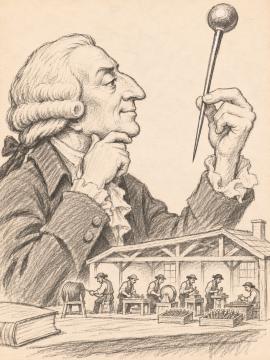
To make a pin, someone has to draw the wire, straighten it, cut it, sharpen it and attach the head. At the beginning of The Wealth of Nations, Adam Smith follows what happens when workers divide those tasks. Together they can make far more pins than if each made a pin from start to finish. From this unassuming object Smith draws one of the central questions of political economy: how does the division of labour change what a society can produce?
Smith (Kirkcaldy, 1723 – Edinburgh, 1790) was a Scottish philosopher and a leading figure of the Scottish Enlightenment. He studied at Glasgow and Oxford and taught logic and moral philosophy at the University of Glasgow. Later, while travelling through France as a private tutor, he met advocates of new economic ideas. Towards the end of his life he worked in the customs administration in Edinburgh.
In The Theory of Moral Sentiments (1759), he starts from our ability to imagine how another person feels, even though we do not experience their feelings directly. This helps explain how we judge other people’s actions and learn to judge our own. His impartial spectator is an imagined person whose standpoint allows us to look at our own conduct, even when nobody is there to reproach us.
In An Inquiry into the Nature and Causes of the Wealth of Nations (1776), he examines prices, wages, profits, trade and taxation. He shows how exchange enables people to specialise, while warning that merchants can act together to raise prices. He assigns government a role in defence, justice and the provision of public works and institutions, including education.
It is worth returning to the worker who repeats the same movement day after day. Smith saw skill at that task as a source of higher output and its monotony as a danger to the worker’s intellectual abilities. The same workshop raises two questions that connect his books: what makes people productive, and what allows them to develop their own judgement?
Titles in our offer

Ueber die Quellen des Volkswohlstandes
Newly edited by Dr. C.W. Asher, corresponding member of the Commission centrale de Statistique du Royaume Belge, the statistical societies of London and Frankfurt a. M. and the Societe d'economie charitable in Paris.