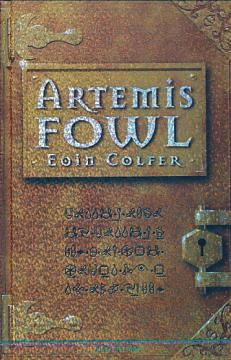
Artemis Fowl

Artemis Fowl

Eoin Colfer

Irish children's writer Eoin Colfer came up with the character of a boy anti-hero in a fantastic setting of a fairy world which, unlike ancient fairy tales, has been modernized with the technology of the future.

All the worries of the world seemed to fall on the fragile shoulders of twelve-year-old Artemis Fowl. His father, otherwise the head of an Irish criminal organization, died after a dubious deal with the Russian mafia. His mother's mind simply went blank with grief. With the help of two loyal servants, Butler and Juliette, Artemis will have to miss the new school year and take control of the family estate and affairs.

But Artemis Fowl is not an ordinary twelve-year-old, he is still his father's son, highly educated, supernaturally cunning and brought up not to choose any means on the way to the goal, neither laws, nor moral considerations, nor terrifying opponents will prevent him from getting his hands on a ton of gold.

Following a series of almost invisible clues, Artemis Fowl discovered that the fairy world really exists, got hold of the fairy book of spells and rules, and planned to kidnap the real fairy, if he could ask for a rich ransom for her according to the complex rules of fairy society. When he actually succeeds, he will find that he actually kidnapped Holly Short, a member of the special elven police force. It looks like Artemis Fowl will finally meet a worthy, if rather charming, opponent.

Translation
Dubravka Petrović
Editor
Neven Antičević
Illustrations
Tony Fleetwood
Dimensions
24 x 16 cm
Pages
2005
Publisher
Algoritam, Zagreb, 2001.
 
Distribution: 3,000 copies
 
Latin alphabet. Hardcover.
Language: Croatian.
ISBN
9-53-220017-7

No copies available

The last copy was sold recently.
 

Are you interested in another book? You can search the offer using our search engine or browse books by category.

You may also be interested in these titles

Tetovirani čovek

Tetovirani čovek

Ray Breadberry

In this book, Bradbury brings science fiction closer to the domains of the so-called same fiction (in the sense in which Lovecraft did it) and poetry in the imaginative playfulness of the language and the controlled emotionality of the statement.

Izdavački zavod Jugoslavija, 1979.
Serbian. Latin alphabet. Paperback.
6.38
Vječni Tuckovi

Vječni Tuckovi

Natalie Babbitt

Imagine that you come across the fountain of eternal youth quite by accident. To live forever, never to grow old, isn't that everyone's dream? For the Tuck family, eternal life is a reality, but that doesn't make them happy at all.

Algoritam, 2005.
Croatian. Latin alphabet. Hardcover.
6.98
Air: or Have Not Have

Air: or Have Not Have

Geoff Ryman

This remarkable novel is about the effects of a new communications technology, Air, that works without power lines or machines.

Golancz, 2005.
English. Latin alphabet. Hardcover with dust jacket.
12.56
Primicanje katastrofa: Propasti koje prijete našem svijetu

Primicanje katastrofa: Propasti koje prijete našem svijetu

Isaac Asimov

A popular science work in which Asimov, combining scientific rigor with a lucid style, explores possible threats to the survival of humanity, systematizing disasters according to their nature and probability.

August Cesarec, 1981.
Croatian. Latin alphabet. Hardcover with dust jacket.
7.46
Četrdeset tisuća milja ispod mora

Četrdeset tisuća milja ispod mora

Jules Verne

The novel Forty Thousand Leagues Under the Sea (also known as Twenty Thousand Leagues Under the Sea, depending on the translation), published in 1870, is one of Jules Verne's most famous works and a classic of science fiction.

Novo pokoljenje, 1951.
Croatian. Latin alphabet. Hardcover with dust jacket.
8.565.99
Ploveće ostrvo

Ploveće ostrvo

Jules Verne

A science fiction novel by Jules Verne that depicts the adventures of musicians from a French quartet who accidentally find themselves on a huge, artificial island powered by motors - a floating continent called Standard Island.

Tehnička knjiga, 1957.
Serbian. Latin alphabet. Hardcover with dust jacket.
The book consists of two volumes
9.56