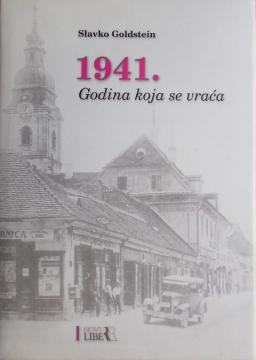
1941. Godina koja se vraća
Rare book

1941. Godina koja se vraća

Slavko Goldstein

The manuscript of author Slavko Goldstein is much more than memoir literature. It is actually an exceptional depiction of a turning point in recent Croatian history... (I. Banac)

This dense text, in which personal and family experiences are intertwined with erudite microhistoriography from Karlovac and Korduna, but also with broader considerations about the nature of the Ustasha and communist movements, is a mosaic of small rounded units, which connects Goldstein's judgments about people and their destinies. In addition to memories, there is a lot of archival and other material, but also a lot of comments on various issues and interpretations of the behavior of individuals. It is solved by a persuasive and lively style, the skill of using illustrative anecdotes and a sense of dramatic plot. However, there are no superfluous or tedious details on any of the 700 cards offered. It's top-notch nonfiction." (from Ive Banac's review)

Editor
Ivo Goldstein
Graphics design
Denis Stankov
Dimensions
24 x 17 cm
Pages
480
Publisher
Novi Liber, Zagreb, 2007.
 
Latin alphabet. Hardcover with dust jacket.
Language: Croatian.

One copy is available

Condition:Used, excellent condition
 

Are you interested in another book? You can search the offer using our search engine or browse books by category.

You may also be interested in these titles

Liburnijske teme 8: Brseč i Brešćina

Liburnijske teme 8: Brseč i Brešćina

"Liburnian Topics" represent a valuable serial publication (proceedings) initiated by the Chair of the Čakavian Parliament in Opatija with the aim of researching and preserving the historical, cultural and natural heritage of the Liburnian region.

Čakavski sabor, 1994.
Croatian. Latin alphabet. Paperback.
12.369.27
Bratovštine i obrtne korporacije u Republici Dubrovačkoj. Svezak II.

Bratovštine i obrtne korporacije u Republici Dubrovačkoj. Svezak II.

Kosta Vojnović

The collection presents an introductory discussion and critical transcriptions of the statutes of the Dubrovnik guilds from the 13th to the 16th centuries. It traces the emergence, organization, and regulations of craftsmen and their changes throughout th

Jugoslavenska akademija znanosti i umjetnosti (JAZU), 1900.
Croatian. Latin alphabet. Hardcover.
34.22
Putovanje po Bosni

Putovanje po Bosni

Ivan Kukuljević Sakcinski

Ivan Kukuljević Sakcinski's travelogue provides a vivid account of Bosnia in the mid-19th century, recording the landscape, customs, political circumstances, and everyday life under Ottoman rule.

Fortuna d.o.o., 2007.
Croatian. Latin alphabet. Hardcover.
14.60
Dubrovačke slike i prilike (1800-1880.)

Dubrovačke slike i prilike (1800-1880.)

Josip Bersa

Josip Bersa's book vividly depicts the social, political, and cultural life of Dubrovnik in the 19th century, combining historical facts and personal memories into a picturesque portrait of the city in a period of change.

Matica hrvatska, 1941.
Croatian. Latin alphabet. Hardcover.
19.54
Spomen-knjiga Matice hrvatske od godine 1842. do godine 1892.

Spomen-knjiga Matice hrvatske od godine 1842. do godine 1892.

Tade Smičiklas, Franjo Marković

This is a jubilee edition on the occasion of the 50th anniversary of Matica Hrvatska, with twelve images and one copy of the manuscript. An overview of the history, work and significance of Matica Hrvatska as the most important Croatian cultural instituti

Matica hrvatska, 1892.
Croatian. Latin alphabet. Paperback.
32.46
Crtice iz slavonske povijesti s osobitim obzirom na prošlost županija: Križevačke, Virovitičke, Požeške, Cisdravske baranjske, Vukovske i Srijemske, te Kr. i slob. grada Osijeka u srednjem i novom vijeku

Crtice iz slavonske povijesti s osobitim obzirom na prošlost županija: Križevačke, Virovitičke, Požeške, Cisdravske baranjske, Vukovske i Srijemske, te Kr. i slob. grada Osijeka u srednjem i novom vijeku

Josip Bösendorfer

In his major work from 1910, Josip Bösendorfer provides an overview of Slavonian history with an emphasis on the past of the counties (Križevci, Virovitica, Požega, Baranja, Vukovo, Srijem) and the city of Osijek in the Middle Ages and the modern era.

Naklada Radoslava Bačića, 1910.
Croatian. Latin alphabet. Hardcover.
86.42